

Quick answer
You can automate the repetitive parts of journalist outreach: monitoring and filtering requests, matching each one to an expert, collecting the journalist's recent articles, drafting a first structure, scheduling sends and logging replies and placements. People should keep the judgment calls: whether a request truly fits, the expert's own answer, credentials, the final review and the tone of any follow-up. Journalists delete pitches that look like mass email, and Qwoted's terms forbid AI-written pitches, so a person should approve every message.
Key facts about automated journalist outreach
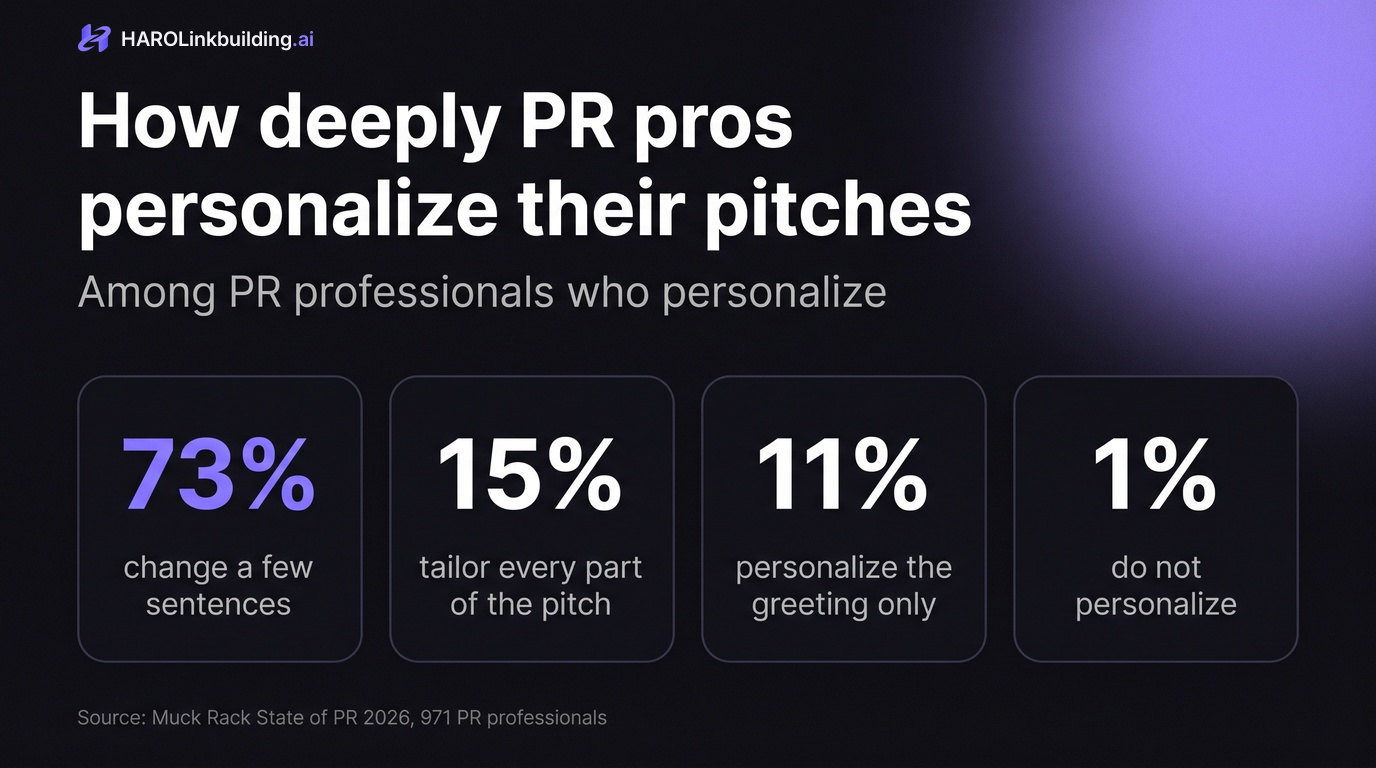
- 66% of PR professionals usually or always personalize their pitches, and 73% of those who personalize change only a few sentences, according to Muck Rack's State of PR 2026.
- 50% of journalists immediately delete a pitch that looks like a mass email, and 35% delete one addressed to the wrong name or outlet, according to Muck Rack's State of Journalism 2026.
- Google requires every sender to Gmail to set up SPF or DKIM and to keep spam rates below 0.3%, and senders of more than 5,000 messages a day must also use DMARC, according to Google's email sender guidelines.
- HARO's Terms of Service do not permit accounts accessed by bots, and they forbid harvesting reporter information from HARO emails for any reason.
- Qwoted's help center says that using AI to write your pitches is against its Terms and Conditions.
Which parts of journalist outreach can you automate safely?
One test sorts every task. Automate a task when a mistake is easy to spot and cheap to fix before anything is sent. Keep a task personal when the journalist will judge you by it, or when an error would put a false claim or a wrong name in front of a reporter.
Applied to a typical expert-sourcing workflow, that test splits the work like this.
| Task | What to automate | What to keep personal |
|---|---|---|
| Finding requests | Monitor digests and feeds, then tag each request by topic, outlet type and deadline. | Decide whether the request truly fits your expert and your buyers. |
| Expert matching | Suggest an expert from a stored profile sheet. | Confirm that the expert has firsthand knowledge of the question. |
| Journalist research | Collect the journalist's recent articles and the outlet's audience. | Pick the one detail that makes your answer relevant to that story. |
| First draft | Arrange the expert's notes into a structure (where the platform allows AI). | Write or approve the answer itself in the expert's words. |
| Credentials | Insert the approved bio and credit line from the profile sheet. | Check that every title, number and claim is current and true. |
| Sending | Queue approved pitches inside the deadline. | Approve each message before it goes out. |
| Follow-ups | Flag replies that are overdue. | Decide whether a follow-up is warranted, then write it. |
| Tracking | Log replies, live stories and link attributes. | Read the results and change your topic list. |
The left column holds the repetitive work. The right column is where journalists decide whether to use your answer, so every item in it needs a named person.
What do journalists and PR pros say about personalization?
PR teams say they personalize, but usually only a little. In Muck Rack's State of PR 2026, which analysed 971 responses from PR professionals, 32% said they always personalize their pitches and 34% said they usually do. That combined 66% is down from 70% the year before.
The depth of that personalization is modest. Among PR professionals who personalize, 73% change a few sentences, 15% tailor every part of the pitch and 11% personalize only the greeting.
Journalists notice the difference. In Cision's 2026 State of the Media survey of 1,899 journalists, 24% said a pitch personalized to them makes them more likely to engage, and 27% named a generic or mass-email feel as a common reason to reject a pitch. Muck Rack's 2026 journalist survey found that 50% immediately delete pitches that look like a mass email. Another 35% delete pitches addressed to the wrong name or outlet, which is the typical error of an unchecked mail-merge field.
Journalists judge relevance by their audience. Muck Rack asked journalists what makes a pitch genuinely relevant to their audience beyond their beat, and the top answer was a direct effect on the community that audience belongs to.

This is the part of personalization that software cannot fake. A tool can fetch a reporter's last five articles. A person has to decide how the expert's answer changes something for that reporter's readers. One journalist in Cision's report said they value PR people who reference their past stories and offer new sources or angles that move the coverage forward.
Volume works against this. Muck Rack's PR survey found that 49% of PR professionals pitch more than 20 journalists per campaign or announcement. One journalist's advice in the 2026 journalism report was "Don't pitch widely; pitch selectively, and then widen as needed."
How do you set up an automated outreach workflow, step by step?
The workflow below suits request platforms such as HARO and direct pitches to journalists you already follow. If you are new to HARO, start with our guide on how to get backlinks through HARO, then add automation to the steps that take the most time.
Step 1: Monitor and filter requests automatically
HARO's terms say sources receive three emails a day, Monday through Friday, at 5:35 a.m., 12:35 p.m. and 5:35 p.m. EST. Set rules in your inbox or tool that tag each request by topic keywords, outlet type and deadline. Send clear matches to the right expert's queue and send borderline matches to a person for a decision.
Keep the automation inside your own inbox. HARO's terms do not permit accounts accessed by bots, and they forbid harvesting reporter information from HARO emails for any reason. Filter the requests, and leave the reporters' details out of any media list. Our guide on how to use HARO as a PR specialist covers filtering criteria for several clients.
Step 2: Match each request to an expert
Keep one profile sheet per expert with their topics, approved credentials, data they can share and the hours they can reply. A tool can compare a request against these sheets and suggest a match. The expert or the PR lead then confirms that the expert has direct experience with the question.
Step 3: Research the journalist's recent work
When the request names the journalist, an automated step can pull their recent articles from the outlet's author page and summarize the angles they cover. A person reads that summary and chooses one detail that connects the expert's answer to the story. When the request is anonymous, research the outlet's audience instead.
Use one specific reference at most. Flattery about a past article adds length without adding value.
Step 4: Draft a first version where the platform allows it
Check the platform's rules before any AI touches the text. Qwoted says that using AI to write pitches is against its terms, warns that even AI rewording or light clean-up can get flagged and tells sources to stick to basic spellcheck. HARO runs AI detection on every pitch, and our article on HARO link building mistakes explains how that filter works.
Where a draft is allowed, use automation to arrange the expert's own notes into a structure: answer first, then one piece of evidence, then the credit line. Keep it short. In Cision's 2026 survey, 100 to 200 words was the most common preference for an expert commentary or source offer, chosen by 25% of journalists.
Step 5: Get the expert's real answer and review it
The expert supplies or approves the substance of every answer. A reviewer then checks the journalist's name and outlet, the expert's title, each number and its source, the link and any commercial tie that needs disclosure. This review catches the wrong-name error that 35% of journalists in Muck Rack's survey say makes them delete a pitch.
Step 6: Send inside the deadline
Queue approved pitches so they go out well before the deadline, and let a person press send or confirm the batch. HARO's terms ask sources to answer through the anonymous @helpareporter.net address in the request. For direct pitches from your own domain, set up the email authentication described in the rules section below.
Step 7: Track replies, follow-ups and placements
Log every pitch with the date, expert, outlet, deadline and outcome. Let your tracker flag pitches with no reply after a set number of days, and let a person decide whether a follow-up is worth sending. In Cision's survey, 64% of journalists said a PR professional should follow up once, 28% said never and 8% said more than once. Muck Rack found that 46% of journalists delete pitches sent repeatedly without a response.
When a story goes live, record the URL, the anchor text and the link attribute. Our HARO SEO strategy guide explains how to measure those links in Search Console.
What does a personalized outreach template look like?
This template was written by our editorial team. The labels show which fields a tool can fill from stored data and which ones a person must write or check.
Subject: [Request headline]: [expert's role] on [specific angle]

Hi [journalist's first name, checked by a person],

[PERSON: one sentence that links this answer to the
journalist's recent story or to the outlet's readers.]

I'm [full name], [job title] at [company].
[TOOL, from the approved bio: one credential that
matches this request.]

[EXPERT, in their own words: a direct answer in one
or two sentences.]

[EXPERT: one number or firsthand example, with
where it comes from.]

Credit: [full name], [job title], [company], [URL]

I can answer follow-up questions until [time and
time zone] at [email or phone].
A tool can safely fill the subject structure, the credit line, the contact details and the stored credential. The opening line, the answer and the evidence must come from people. If any field is blank or uncertain at review, the pitch waits.
How do HARO and other request platforms limit automation?
Request platforms add their own rules on top of email law, and those rules set the outer limit for what you can automate.
- HARO: The terms say sources may contact journalists only with relevant responses to specific queries, and agencies must reply with the client's actual response. Bot access and harvesting reporter information are not permitted.
- HARO enforcement: In a September 2026 post, HARO said it bans an account every 23 minutes. Journalists can mark a response as not helpful, and that signal goes to an internal team. Asked whether a pitch drafted with an AI tool from Featured, which owns HARO, should be edited by a person before sending, HARO CEO Brett Farmiloe agreed that "you have to look at it."
- Qwoted: AI-written pitches are against its terms, and its help center says most journalists cannot use AI-generated content in their stories.
The safe pattern on every platform is the same. Automate the reading, sorting and logging, and keep the writing and sending under human control. Our comparison of HARO alternatives covers the other platforms and how each one works.
Which email rules apply to automated journalist outreach?
Replies through a platform's own address follow that platform's rules. Pitches sent from your own domain also have to meet mailbox provider requirements, and some may fall under commercial email law. This section is general information and not legal advice.
Google's requirements took effect on February 1, 2024. All senders to Gmail need SPF or DKIM, a TLS connection and a spam rate below 0.3% in Postmaster Tools. Senders of more than 5,000 messages a day to Gmail accounts also need DMARC, and their marketing and subscribed messages must support one-click unsubscribe. Google's sender FAQ says messages from the same primary domain count toward that limit, and a sender who reaches it once is permanently treated as a bulk sender. Google also says it began ramping up enforcement on non-compliant traffic in November 2025.

A focused outreach program may never reach 5,000 messages a day, but the rules for all senders still apply. Each journalist who marks a pitch as spam adds to the spam rate that Google measures for your domain.
| Rule | Who it covers | Main requirements | What it means for outreach |
|---|---|---|---|
| Google sender guidelines | Everyone sending to Gmail, with extra rules above 5,000 messages a day | SPF or DKIM, TLS, spam rate below 0.3%; DMARC and one-click unsubscribe for bulk marketing mail | Authenticate your sending domain before you send any pitch. |
| Yahoo sender best practices | Bulk senders to Yahoo | SPF and DKIM, DMARC with at least p=none, one-click unsubscribe, unsubscribes honored within 2 days, spam rate below 0.3% | Honor any request to stop quickly and remove that journalist from future sends. |
| FTC CAN-SPAM guide | Commercial email, including business-to-business | Honest headers and subject lines, identification as an ad, a postal address, an opt-out method and opt-outs honored within 10 business days | Follow these rules for any pitch whose main purpose is to promote a product. |
The FTC says the law covers all commercial messages and that the "primary purpose" of a message decides whether it is commercial. It makes no exception for business-to-business email. The FTC also says you cannot contract away your responsibility when someone else sends on your behalf, and each violating email can bring a penalty of up to $53,088. If an agency or tool sends pitches for you, you remain responsible for what it sends.
Should you build the workflow in-house or use a service?
Build it in-house when you have a person who can review requests every weekday and an expert who replies within hours. Simple inbox filters, a shared profile sheet and a tracker cover most of the automation in the table above. Our guide to the best AI link building tools covers software options for these steps.
Keep one boundary in every setup. Google's spam policies list "using automated programs or services to create links to your site" as an example of link spam. Automation should help your expert answer journalists faster, and every link should remain the publisher's editorial choice. Our article on AI link building explains how AI fits into link building more broadly.
A service makes sense when nobody on your team has time for daily triage. HAROLinkbuilding.ai uses an AI agent to monitor requests and draft pitches from your expert's input, and a person approves every pitch before it is sent. You can compare plans on our pricing page.
Frequently asked questions
Can I use AI to write pitches to journalists?
It depends on the platform. Qwoted's help center says using AI to write pitches is against its Terms and Conditions, and HARO says it runs AI detection on every pitch it receives.
Can I scrape HARO requests into a media list?
HARO's terms rule it out. They do not permit accounts accessed by bots, and they forbid harvesting reporter information from HARO emails for any reason.
Do Google's bulk sender rules apply to PR pitches?
Google treats a sender as a bulk sender after close to 5,000 messages or more to personal Gmail accounts within 24 hours from the same primary domain. Every sender, whatever the volume, needs SPF or DKIM and a spam rate below 0.3%.
Does CAN-SPAM apply to journalist outreach?
The FTC says CAN-SPAM covers all commercial messages, makes no exception for business-to-business email and judges a message by its primary purpose. A pitch whose main purpose is to promote a product is more likely to count as commercial.
How many times should I follow up with a journalist?
In Cision's 2026 State of the Media survey, 64% of journalists said a PR professional should follow up once, 28% said never and 8% said more than once.
How much do PR professionals personalize their pitches?
Muck Rack's State of PR 2026 found that 66% usually or always personalize their pitches. Among those who personalize, 73% change a few sentences and 15% tailor every part of the pitch.