

Quick answer
HARO link building supports your SEO strategy by earning editorial links and expert mentions on real publications. Google says it uses links as a signal for relevance and for finding new pages, and that links or references from prominent websites are one of many factors it uses to judge quality. HARO cannot promise a link, a followed link or a ranking change. Run it as one part of your plan, next to helpful content and sound technical SEO, and measure it in Search Console.
Key facts about HARO SEO
- Google says it "uses links as a signal when determining the relevancy of pages and to find new pages to crawl", according to its link best practices.
- Google lists whether "other prominent websites link or refer to the content" as one of the factors it uses to determine quality, in its explanation of how ranking works.
- Google treats the nofollow, sponsored and ugc link attributes as hints, according to its 2019 announcement on evolving nofollow.
- HARO is free for sources, and its submission guidelines ban backlink solicitation in journalist queries.
- About 27% of links cited by AI assistants come from journalistic sources, according to Muck Rack's analysis of more than 25 million cited links in What Is AI Reading? (May 2026).
What does Google say about links and editorial mentions?
Google's public documentation gives links a clear but limited role. Its link best practices say links help it judge relevance and discover new pages. Its ranking overview says one quality factor is whether other prominent websites link to or refer to a page, which it calls "generally a good sign that the information is trustworthy."
The same page says Google's algorithms look at many factors and signals, including the words of the query, the relevance and usability of pages, the expertise of sources, and the searcher's location and settings. It also says the weight of each factor varies with the nature of the query. A HARO placement therefore adds to the evidence Google can use, and it works alongside every other factor.
Google's spam policies define link spam as creating links "primarily for the purpose of manipulating search rankings." HARO placements fit the safe side of that line when a journalist chooses your answer on merit and the publication decides how to credit you. HARO's own guidelines support this, because they bar journalists from using queries for guest blogging, link exchanges or backlink requests. Our guide to getting backlinks through HARO covers the practical rules for staying on that safe side.
How does Google treat nofollow, sponsored and ugc links?
Publishers decide how to mark their outbound links. Some leave a link with no qualifier, and others add a rel attribute to every external link. Google's guidance on qualifying outbound links describes three values, and it says links marked with them "will generally not be followed."
| Link markup | What Google says it is for | What it means for a HARO placement |
|---|---|---|
| No rel qualifier | Google's link guidance says nofollow is for sources a site does not trust, so ordinary editorial links need no qualifier. | Google can use the link as a signal like any other link it finds. |
| rel="nofollow" | It marks links where no other value applies and the site would rather Google not associate it with, or crawl, the linked page. | Some publishers apply it to every external link. The mention can still bring referral traffic and brand visibility. |
| rel="sponsored" | It marks advertisements or paid placements. | This value should never appear on an earned quote. If it does, the placement may have been sold as advertising. |
| rel="ugc" | It marks user-generated content such as comments and forum posts. | This value is rare for a quote inside an article. It usually signals a comment or community section. |
Since 2019, Google has said that all three values "are treated as hints about which links to consider or exclude within Search." For crawling and indexing, nofollow became a hint on March 1, 2020. Google has not published how often it uses a qualified link, so plan your reporting as if a qualified link passes little or no ranking value and record its other benefits separately.
How do HARO mentions relate to E-E-A-T and reputation?
E-E-A-T stands for experience, expertise, authoritativeness and trustworthiness. Google's helpful content guidance says "E-E-A-T itself isn't a specific ranking factor" and that trust is the most important of the four.
Google also trains search quality raters to judge E-E-A-T. The same page says "Search raters have no control over how pages rank" and that rater data is not used directly in ranking algorithms. Google adds that reading the guidelines may help you self-assess your content, so they are a useful check.
The September 2025 Search Quality Rater Guidelines tell raters to ask what "outside, independent sources" say about a website and its content creators. They list news articles, magazine articles and expert recommendations as sources of reputation information. When a site's claims and independent sources disagree, raters are told to trust the independent sources.
A HARO quote adds to that independent record for two entities at once. The publication names your company, and it also names your expert as a person with relevant knowledge. You can check the record yourself with the search raters use, for example [yourbrand -site:yourbrand.com], and review what independent sites say about you.
The guidelines also say a small website with little reputation information is "not indicative of high or low quality." A thin record of coverage is common for young B2B companies, and steady expert quotes are one honest way to build it over time.
Do expert mentions help your visibility in AI search?
Google says the best practices for SEO remain relevant for its AI features. In its words, "There are no additional requirements to appear in AI Overviews or AI Mode, nor other special optimizations necessary." The fundamentals that support your normal search visibility therefore apply to AI features too.
Industry research shows that AI assistants lean heavily on earned media when they cite sources. Muck Rack analyzed more than 25 million links cited by ChatGPT, Claude and Gemini in its May 2026 report. It found that about 99% of cited links came from non-paid media, about 84% from earned media and about 27% from journalism.
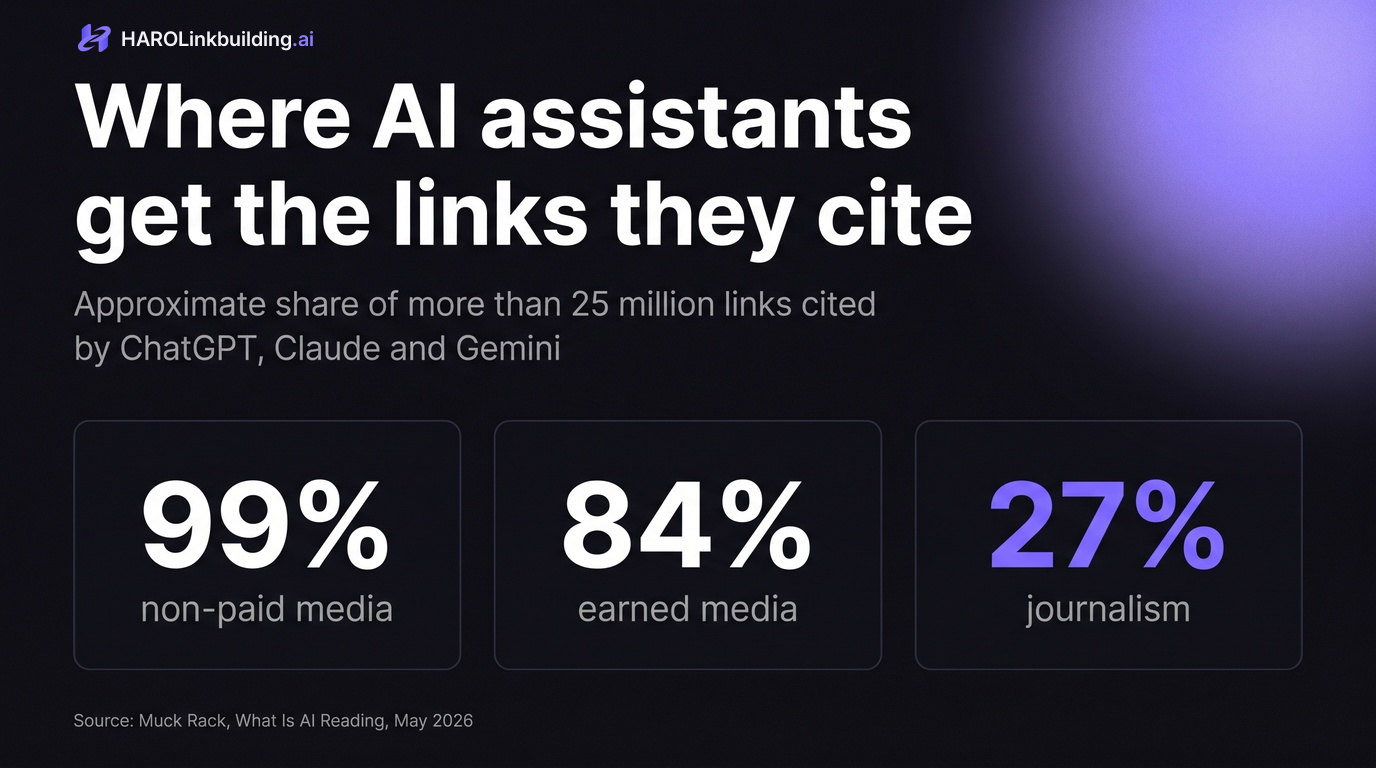
Read these figures with care. Muck Rack sells a product that tracks brand visibility in AI answers, and its study measures which kinds of pages AI assistants cite. It does not measure HARO quotes directly, and the report itself notes that model behavior may shift as models are updated.
Two further findings matter for choosing queries. Industry trend questions drew journalism citations in 46% of responses, more than twice the rate of how-to and comparison questions. Among journalism citations with a known publish date, 57% were published within the previous 12 months.

Clicks are also harder to win when an AI summary appears. Pew Research Center tracked the browsing of 900 U.S. adults in March 2025. Users who saw an AI summary clicked a traditional search result in 8% of visits, compared with 15% for users who saw no summary, and they clicked a link inside the summary in only 1% of visits.
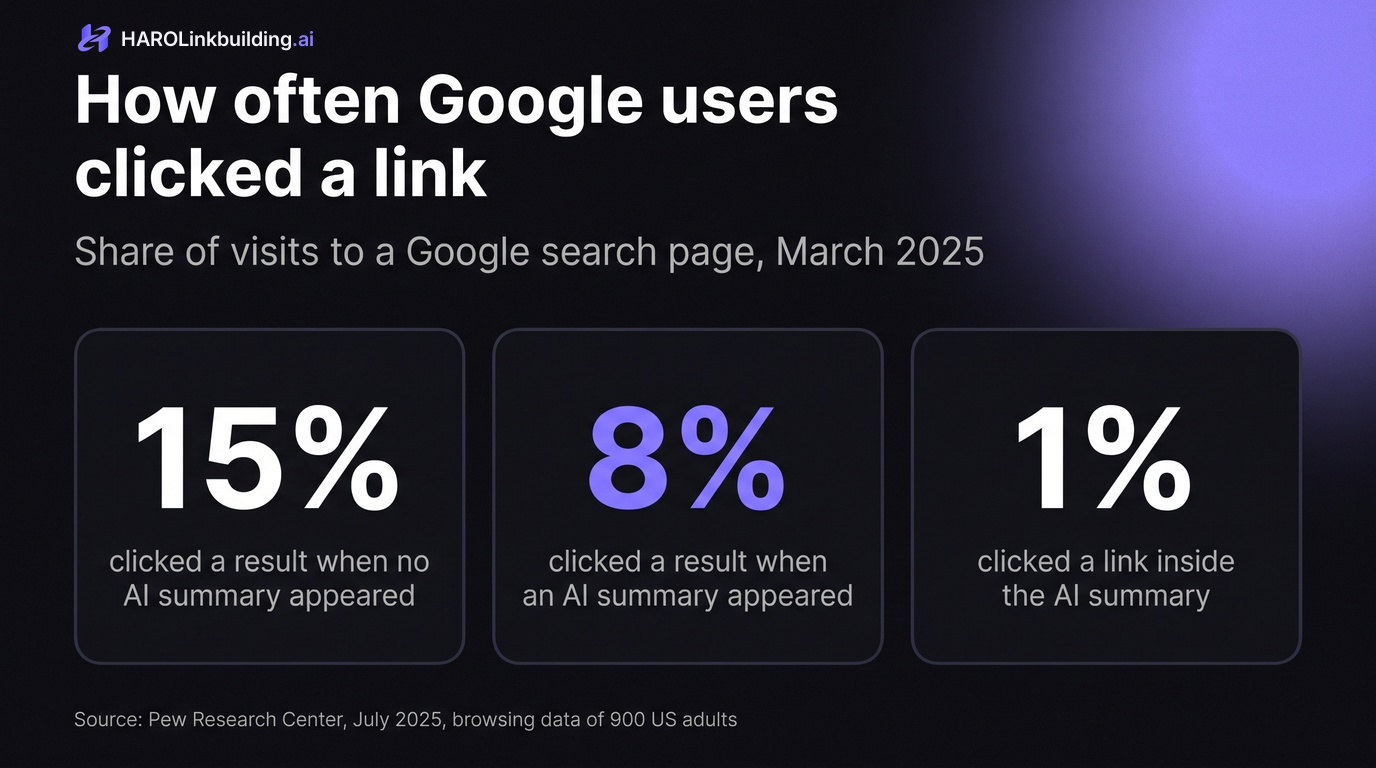
Taken together, the data suggests that a named mention in a trusted article can reach readers even when they never click a search result. It does not prove that a single quote will change what an AI assistant says about you. Track brand mentions as a result in their own right, alongside links.
How do you pick HARO queries that fit your target pages?
Filtering queries by expertise is the first step. An SEO lead should also ask which page on your site the coverage can support. Use these five steps to connect each pitch to a page.
- List five to ten pages you want to support, such as a research page, a core guide, a service page and your expert bio pages.
- Write down the topic each page covers and the expert who can speak about it with authority.
- When a query matches a topic, decide which page would help the journalist's readers if they followed a link.
- Offer that single URL in your credit line, and accept the journalist's choice if they link elsewhere.
- Record the target page in your placement log so you can measure each page later.
| Query type | Page to offer | Why it fits |
|---|---|---|
| Industry trend or forecast | A research or data page | The page backs up the claim in your quote. |
| How-to or practical tips | A detailed guide on the same task | Readers who want more depth find it in one click. |
| Expert opinion or commentary | The expert's bio page | The page shows the credentials behind the quote. |
| Company, founder or funding story | Your homepage or about page | The story is about the company as a whole. |
Keep a simple map so the person reading each digest can make this choice quickly. Here is an example written by our editorial team, with placeholders for your own pages:
For the daily filtering routine, see our guide on how to use HARO as a PR specialist.
What anchor text should you expect from HARO links?
Journalists and editors write the link, so you rarely control the anchor text. Credits often use your company name, the expert's name, a bare URL or a phrase from the sentence around your quote. That variety is normal for editorial coverage.
Google's link best practices say "good anchor text is descriptive, reasonably concise, and relevant" to both pages. Its spam policies list "links with optimized anchor text in articles, guest posts, or press releases distributed on other sites" among the examples of link spam. Asking a journalist for a keyword-rich anchor moves an earned placement toward that example and risks the relationship.
Give the journalist a clean credit line with your name, title, company and one URL. The Search Console Links report includes a top linking text table, and Google suggests using it to "confirm that other sites are describing your site accurately." Use it to check how coverage describes you over time.
How do you measure HARO's impact in Search Console?
No single report shows the SEO effect of a HARO placement. Combine your own log with Search Console and your analytics tool, and follow these steps each month.
- Log each published story with its date, outlet, expert, target page and link status. Our guide on how to respond to HARO queries explains how to check whether your answer ran.
- Open each live story and inspect the link markup. Google says the Links report "doesn't specify if a link is marked as nofollow."
- Check the Links report for new linking sites and for changes to your top linked pages. Google says the report shows a sample of links, so keep your own log as the full record.
- In the Performance report, filter by each target page and compare clicks, impressions and queries with the period before the placement.
- Use the branded queries filter to watch searches for your brand name. Google made it available to all eligible sites on March 11, 2026, although sites with few impressions cannot use it.
- Check referral sessions from each story in your analytics tool.
Google says traffic from AI Overviews and AI Mode is included in the Performance report under the Web search type, so you will not see it as a separate line. Also note other changes from the same period, such as new content or site fixes. A rise in impressions after one placement can be a coincidence, so look for a pattern across several months before you draw conclusions.
Here is an example report layout written by our editorial team:
What results should you expect from HARO SEO?
We have not found a reliable public benchmark that links HARO placements to ranking changes. Google weighs many factors, and their weight changes by query, so nobody can promise a ranking gain from a set number of links. Treat any offer of guaranteed rankings from HARO links as a warning sign.
| Realistic expectation | Unrealistic expectation |
|---|---|
| Some published quotes include a link, and some do not. | Every published quote includes a followed link. |
| Links from relevant publications add to the evidence Google sees about your site. | A set number of links produces a set ranking gain. |
| Named quotes build an independent record for your brand and your expert. | One article changes how AI assistants describe your company. |
| Results appear over months and depend on your topics and your expert. | Results appear within days of the first placement. |
Set leading indicators you control, such as pitches sent, stories published and links earned per target page. Review them with your search data each quarter, and change topics when a page receives no relevant coverage.
Where does HARO fit next to content and technical SEO?
HARO works best when the rest of your SEO is in order. A link to a page that Google cannot crawl or index adds little, and a link to a thin page gives readers little reason to stay.
| Workstream | Main job | How HARO connects |
|---|---|---|
| Technical SEO | Makes sure Google can crawl, index and render your pages. | Earned links are most useful when they point to pages Google can find and index. |
| Content | Builds helpful pages that answer real questions. | Strong pages give journalists a useful page to link and readers a reason to stay. |
| HARO and digital PR | Earns independent links and mentions from publications. | Adds outside evidence of expertise to the pages and people you already have. |
| Measurement | Tracks pages, queries and brand demand. | Connects each placement to a target page and a time period. |
Fix technical issues on your target pages first, then make sure each page is worth citing, and then pitch. When you are ready to write, our 10 HARO pitch examples show how to answer common query types.
Your team can run HARO in-house or hand the daily digest review to someone else. Our service runs HARO with an AI agent and human approval, for teams that have the expertise but limited time for digests. You can compare plans on our pricing page.
Frequently asked questions
Do HARO links help SEO?
They can contribute. Google says it uses links as a signal for relevance and for finding new pages, and that links or references from prominent websites are one of many factors it uses to judge quality. No single link guarantees a ranking change.
Are nofollow HARO links worthless?
Google says links marked nofollow, sponsored or ugc will generally not be followed, and it has treated all three as hints since 2019. A qualified link can still bring referral traffic and put your brand in front of readers.
Can I ask a journalist for specific anchor text?
You should avoid it, because Google's spam policies list links with optimized anchor text in articles, guest posts or press releases among their link spam examples. Give the journalist a plain credit line with one URL.
Is E-E-A-T a ranking factor?
Google says E-E-A-T itself is not a specific ranking factor. Its systems use a mix of factors that can identify content with good E-E-A-T, and Google calls trust the most important part.
Do HARO mentions help in AI search?
Google says there are no additional requirements or special optimizations for AI Overviews or AI Mode. Muck Rack's May 2026 study found that about 27% of links cited by AI assistants come from journalism, although it does not measure HARO quotes directly.
How do I see HARO links in Search Console?
The Links report shows a sample of your external links, including top linking sites and top linking text. Google says it does not specify whether a link is nofollow, so inspect each live story yourself.
Can journalists ask for backlinks on HARO?
HARO does not allow it. Its submission guidelines say guest blogging, link exchanges and backlink solicitation are not allowed in queries.