
Quick answer
The HARO link building mistakes that cost the most backlinks are pitching outside your expertise, replying late, sending generic or fully AI-written answers, ignoring the query's instructions, asking for a link, attaching files, overstating credentials, going quiet when a journalist replies, judging outlets only by link type and failing to track results. Each mistake either gets your pitch skipped or puts your account at risk. HARO's 2026 data shows that human-written pitches are about three times more likely to be featured than AI-written ones.
Key facts about HARO link building mistakes
- Human-written pitches are about three times more likely to be featured than AI-written ones, and 35% of journalists filter out AI-flagged responses, according to HARO's analysis of more than 2 million pitches.
- HARO bans a user roughly every 23 minutes, primarily for spam and terms-of-service violations, according to the same analysis.
- HARO's Terms of Service tell sources not to spam reporters with off-topic pitches, and they say attachments are stripped from replies automatically.
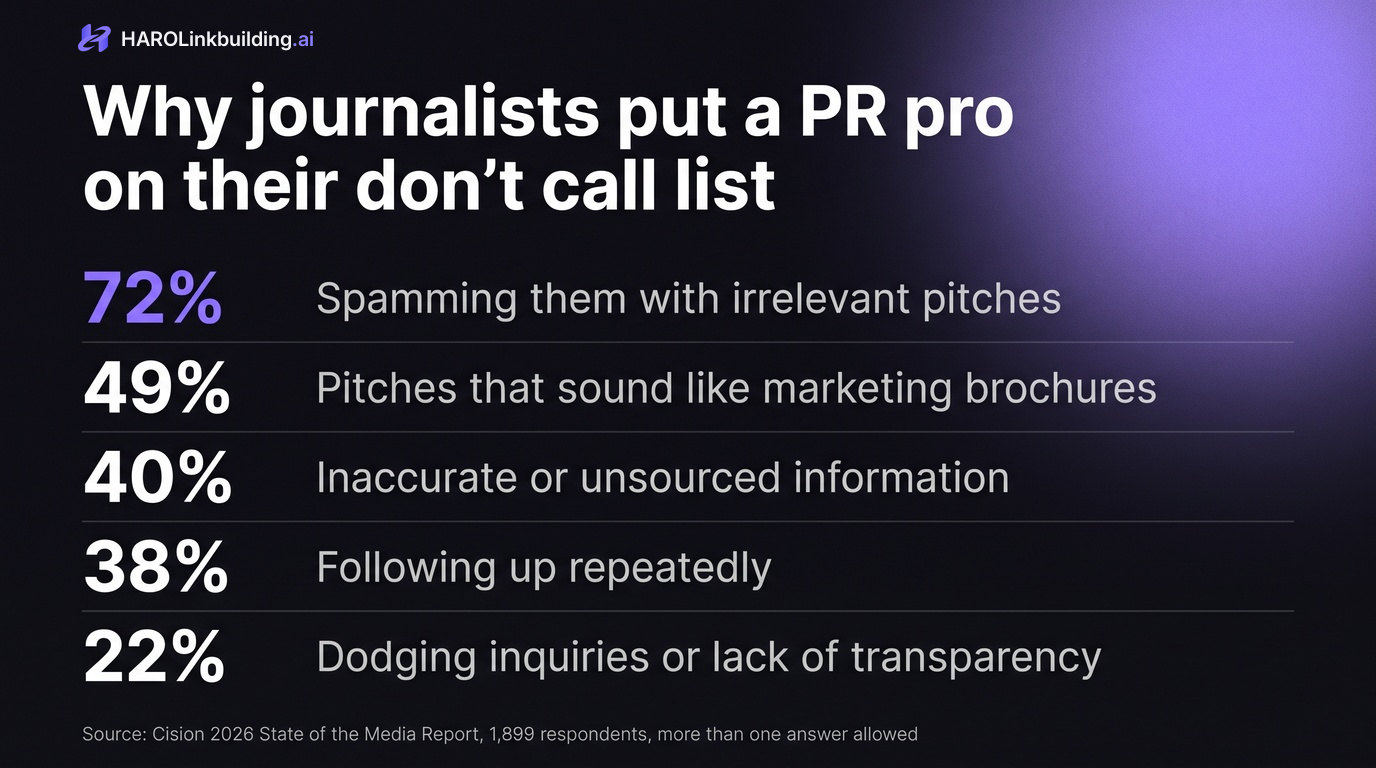
- 72% of journalists say spamming them with irrelevant pitches is a reason to block a PR professional or put them on a "don't call" list, according to Cision's 2026 State of the Media Report.
- Only 3% of journalists say the pitches they receive are always relevant to their coverage, and 17% say usually, according to Muck Rack's State of Journalism 2026.
What are the 10 HARO link building mistakes?
The table lists each mistake, the evidence that it costs you and the fix. If you are new to HARO, start with our step-by-step guide to getting backlinks through HARO.
| # | Mistake | Why it costs the link | Fix |
|---|---|---|---|
| 1 | Pitching queries outside your expertise | HARO's terms bar off-topic pitches. | Pitch only when the expert meets every stated requirement. |
| 2 | Replying after the useful window | A single query can draw dozens of responses before the deadline. | Review each digest on a set schedule with an expert sheet ready. |
| 3 | Sending generic or fully AI-written pitches | 35% of journalists on HARO filter out fully AI-generated responses. | Let the expert supply every fact and opinion. |
| 4 | Ignoring the query's requirements | HARO asks for complete answers, a short bio and contact details. | Answer each question in the order and format requested. |
| 5 | Asking for a link or a specific anchor | Google lists required links and optimized anchor text among its link spam examples. | Give a plain URL in your credit line. |
| 6 | Attaching files | HARO strips attachments from replies automatically. | Put the answer in the email body and share files by link. |
| 7 | Weak or overstated credentials | HARO bans sources permanently for misrepresenting credentials. | Lead with one verifiable credential that fits the query. |
| 8 | Going quiet when the journalist replies | 13% of journalists would block a PR professional for a late reply. | Confirm the expert's availability before you pitch. |
| 9 | Judging outlets by link type and authority alone | Each publisher decides whether and how to link. | Choose outlets your buyers read, and count mentions too. |
| 10 | Not tracking placements and links | Search Console shows only a sample of links. | Log every pitch and inspect each live story yourself. |
Mistake 1: Pitching queries outside your expertise
What goes wrong: A query mentions a keyword close to your field, so you answer it with general advice. The expert has no direct experience with the topic, and the answer shows it.
Why it costs the link: HARO's terms say a source may respond only with information that answers the specific query, and they tell sources not to spam reporters with off-topic pitches. Journalists already receive too many poor matches. In Muck Rack's 2026 survey, 43% of journalists said they seldom receive pitches relevant to what they cover.

HARO's own analysis found that ten highly relevant pitches consistently outperform a hundred generic ones.
The fix: Keep a written list of the topics each expert can cover, and pitch only when the expert meets every stated requirement. The five-question filter in our HARO backlinks guide works as a quick test.
Mistake 2: Replying after the useful window
What goes wrong: The morning digest sits unread until the afternoon, or a draft waits a day for approval. By the time the reply goes out, the journalist already has the sources they need.
Why it costs the link: HARO sends three digests a day, Monday through Friday, at 5:35 a.m., 12:35 p.m. and 5:35 p.m. EST. HARO's blog says a single query can receive dozens of responses. It also warns that being first is worthless if the response is not useful, and it advises sources to be the first great response by having credentials ready before a relevant query appears.
The fix: Assign one person to each digest and keep an expert sheet with an approved bio, credit line and key facts. We have not found a public benchmark for the best reply time on HARO, so compare your selection rate with how early you sent each pitch.
Mistake 3: Sending generic or fully AI-written pitches
What goes wrong: Someone pastes the query into a chatbot and sends the output, or reuses one template answer across many queries. The result reads smoothly and offers nothing a journalist could not find elsewhere.
Why it costs the link: HARO runs AI detection on every pitch. In its 2026 analysis, 21% of pitches were flagged as entirely AI-generated, and 35% of journalists chose to filter out AI-flagged responses. Featured CEO Brett Farmiloe points out that this filter is unchecked by default, so every journalist who uses it has switched it on deliberately. For those journalists, a fully AI-written pitch never reaches a person.
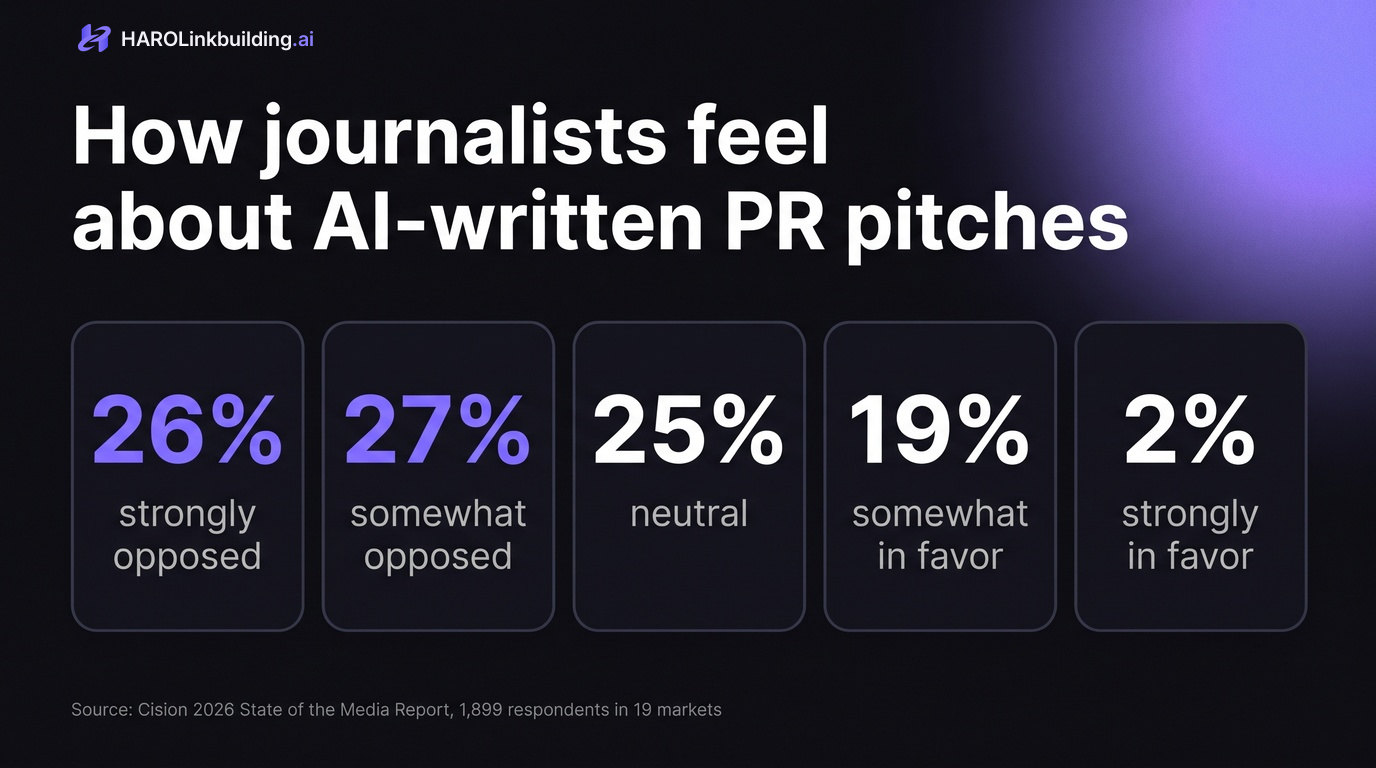
Journalist surveys show the same resistance. In Cision's 2026 survey, 53% of journalists opposed PR professionals using AI to generate pitches or press releases, 25% were neutral and 21% were in favor. In North America, 39% were strongly opposed.
Pangram Labs, whose detector HARO uses, reports that HARO does not ban sources solely for AI-generated pitches. Those pitches can still trigger internal monitoring.
The fix: Use AI to sort digests and format drafts. The named expert should supply every number, example and opinion, and a person should approve the final text. The AI section of our HARO backlinks guide shows how to split the work.
Mistake 4: Ignoring the query's requirements
What goes wrong: The journalist asks three questions and you answer one. Or the query asks for a two-sentence tip from a licensed professional, and you send a 400-word essay from a marketing manager.
Why it costs the link: HARO's terms ask sources to reply with complete, relevant answers, a short bio and contact information. They rule out replies that only say you would like to talk, and agency replies that only say the client can speak about the topic. Farmiloe's advice is to follow the journalist's instructions exactly, so a request for two sentences gets two sentences. HARO's pitch tips also describe a thumbs-up and thumbs-down button that asks journalists whether a pitch was responsive. A thumbs down sends the source feedback that the response missed the mark.
The fix: Copy each question from the query into your draft and answer them in order. Match the word limit, the format and the credential the journalist asked for, then add a short bio and your contact details. Our guide on how to respond to HARO queries walks through each part of a query.
Mistake 5: Asking for a link or a specific anchor
What goes wrong: The pitch asks the journalist to link to a pricing page with a keyword-rich anchor, or it makes the quote conditional on a link.
Why it costs the link: HARO's terms prohibit promotion and solicitation except for relevant information in response to a specific query, and they tell sources not to pitch products unless the query asks for one. HARO's submission guidelines also bar journalists from using queries for link exchanges or backlink solicitation, so link trading falls outside the platform's rules on both sides.
Search engines draw the same line. Google's spam policies list two relevant examples of link spam. The first is requiring a link without letting the publisher qualify it. The second is optimized anchor text in articles, guest posts or press releases on other sites. Journalists also dislike promotion: 49% in Cision's survey named pitches that sound like marketing brochures as a reason to block a PR professional.
The fix: End the pitch with a credit line that gives the expert's name, title, company and a plain URL. Let the editor decide whether to link. If a story credits you without a link, send one polite note with the correct URL and accept the answer.
Mistake 6: Attaching files
What goes wrong: You attach a headshot, a PDF report or a chart, and the journalist receives an email with none of them.
Why it costs the link: HARO's terms tell sources not to include attachments, because attachments are stripped from replies automatically to protect reporters from viruses. If your key number lives only in the attachment, the journalist sees a pitch with no evidence.
The fix: Put the answer and the key data point in the body of the email. Host the headshot, report or chart on a service such as Dropbox, as HARO's terms suggest, and paste the link. Check that the link opens without a login.
Mistake 7: Leading with weak or overstated credentials
What goes wrong: The pitch buries the expert's qualifications at the end, uses a vague title such as "industry expert", or stretches a credential to fit the query.
Why it costs the link: HARO's pitch tips say journalists want to see a source's qualifications and verify them quickly. They also warn that misrepresenting credentials results in a permanent ban. Unsupported claims hurt too: 40% of journalists in Cision's survey named inaccurate or unsourced information as a reason to block a PR professional.
The fix: Open with one credential that matches the query, such as a license, a role or years of direct experience. Add a link to the expert's bio or press page so the journalist can check it. Name the source of every number. Our HARO pitch examples show how to place a credential in the first two lines.
Mistake 8: Going quiet when the journalist replies
What goes wrong: The journalist asks for a full quote or a short call, and the expert is travelling or the approval takes two days.
Why it costs the link: HARO says a journalist who selects a source reaches out directly to gather the full quote or conduct an interview. In Cision's survey, 22% of journalists said dodging inquiries or a lack of transparency would put a PR professional on their "don't call" list. Another 19% named last-minute cancellations, and 13% named failing to respond the same day or within the deadline. One journalist in the report said they start blocking a sender's email when a promised expert drops out just before deadline.
The fix: Before you pitch, confirm that the expert can answer follow-up questions before the deadline. Give a direct phone number and name a backup contact. Our guide on how to use HARO as a PR specialist covers fast client approvals.
Mistake 9: Judging outlets by link type and authority alone
What goes wrong: Some teams skip strong outlets that add nofollow to outbound links. Others answer any query from any site that might give a followed link.
Why it costs the link: HARO says a published source is credited, often with a link back to their website, so a link is never promised. The publisher chooses the link attribute. Google says links marked nofollow, sponsored or ugc will generally not be followed, and since 2019 it has treated these attributes as hints about which links to consider.
HARO does screen outlets. Its guidelines require a Domain Authority of at least 20 or at least 10,000 monthly visitors, and HARO rejects about 32% of journalist requests during approval. That floor is low, so judging fit remains your job. Farmiloe suggests checking whether an outlet gets cited in AI search answers for your category, since a small niche publication can matter more than its size suggests.
The fix: Score each outlet on audience fit, editorial quality and whether AI assistants cite it. Count followed links, qualified links and unlinked mentions separately. Our HARO link building SEO strategy explains how placements fit a wider SEO plan.
Mistake 10: Not tracking placements and links
What goes wrong: Stories go live without notice, links change, and nobody knows which pitches worked.
Why it costs the link: The Search Console Links report shows a sample of links, does not say whether a link is nofollow and may list links that have since been removed. Without your own log, you cannot see your selection rate or tell which topics earn links.
The fix: Log every pitch with the query date, outlet, expert, status, story URL, link attribute, anchor text and target page. Open each live story and inspect the link yourself. Review your selection rate and link rate each month, and recheck older placements every quarter so you notice removed links.
Which HARO mistakes should you fix first?
The ten mistakes carry different costs. Some lose a single placement, while others can cost you a journalist relationship or the account itself. Fix them in this order.
| Priority | Mistakes | What is at stake |
|---|---|---|
| 1. Account risk | Off-topic pitching (1), mass AI pitches (3), misrepresented credentials (7) | HARO bans a user roughly every 23 minutes, primarily for spam and terms-of-service violations. Misrepresenting credentials leads to a permanent ban. |
| 2. Relationship risk | Promotional link requests (5), going quiet (8) | Journalists name irrelevant, promotional and unreliable behavior as reasons to block a PR professional. |
| 3. Placement risk | Late replies (2), missed requirements (4), attachments (6) | The journalist uses another source for that story. |
| 4. Measurement risk | Link-type bias (9), no tracking (10) | You overlook useful outlets and lose sight of links you already earned. |
HARO's team reviews journalist reports and other signals together, then warns the user, bans the account or takes no action.
How do you check a HARO pitch before you send it?
Our editorial team wrote this checklist, with one line for each mistake. Run every draft through it before you send.
HARO PRE-SEND CHECKLIST (example by our editorial team)

[ ] 1. The expert meets every requirement in the query.
[ ] 2. The pitch goes out well before the deadline.
[ ] 3. The expert supplied the facts and approved the text.
[ ] 4. Every question is answered, in order and format.
[ ] 5. The pitch asks for no link and names no anchor.
[ ] 6. Nothing is attached, and file links open without login.
[ ] 7. Line one or two states a verifiable credential.
[ ] 8. [Expert name] is free for follow-ups until [deadline].
[ ] 9. The outlet suits [your buyers] whatever the link type.
[ ] 10. The pitch is logged in [your tracking sheet].
If your team has the expertise but not the hours to read every digest, our service uses an AI agent to find relevant queries and draft answers, and a person approves each one. You can compare plans on our pricing page.
Frequently asked questions
What is the most common HARO link building mistake?
Pitching queries that do not match your expertise is the most common mistake. HARO's terms tell sources not to spam reporters with off-topic pitches, and 72% of journalists in Cision's 2026 survey said irrelevant pitches are a reason to block a PR professional.
Can I ask a journalist for a backlink in my HARO pitch?
You should avoid it. HARO's terms prohibit promotion beyond a relevant answer to the query, and Google lists required links and optimized anchor text among its link spam examples. Give a plain URL in your credit line and let the editor decide.
Can I attach files to a HARO pitch?
HARO's terms say attachments are stripped from replies automatically to protect reporters from viruses. Share headshots, reports and charts through a link from a service such as Dropbox instead.
Will HARO ban me for using AI to write pitches?
Pangram Labs reports that HARO does not ban sources solely for AI-generated pitches, although those pitches can trigger internal monitoring. HARO withholds fully AI-generated pitches from the 35% of journalists who choose to filter them out.
Can HARO ban my account?
HARO's terms allow it to suspend or terminate accounts, and HARO says it bans a user roughly every 23 minutes, primarily for spam and terms-of-service violations. Its pitch tips warn that misrepresenting your credentials results in a permanent ban.
Are nofollow links from HARO placements worthless?
Google says links marked nofollow, sponsored or ugc will generally not be followed. Since 2019, Google has treated these attributes as hints about which links to consider or exclude, so record every placement and judge each outlet on audience fit.
How fast should I reply to a HARO query?
HARO sends digests at 5:35 a.m., 12:35 p.m. and 5:35 p.m. EST, Monday through Friday, and each query sets its own deadline. HARO advises sources to be the first great response, so prepare credentials in advance and send a useful answer well before the deadline.