

Quick answer
To use HARO as a PR specialist, give each team member their own source account at helpareporter.com and match the three weekday digests against a written topic map for every client. Score each query, draft answers from the client's real expertise, and get the client's sign-off before you send. Reply with the client's actual answer, disclose any relevant connections, and log every pitch so you can report placements, link attributes and referral traffic each month.
Key facts for PR professionals using HARO
- HARO is operated by Featured and is free for both journalists and sources, according to HARO's About page.
- Sources receive three emails a day, Monday through Friday, at 5:35 a.m., 12:35 p.m. and 5:35 p.m. EST, according to HARO's terms of service.
- The same terms tell agencies replying for a client to send the client's actual response, and they rule out replies that only say the client can speak about the topic.
- 52% of journalists expect a PR professional to respond within 24 hours, and 30% expect a reply within an hour, according to Cision's 2026 State of the Media Report.
- 58% of journalists want interview access to relevant sources with a pitch, and 88% immediately delete pitches that miss their coverage area, according to Muck Rack's State of Journalism 2026.
- HARO bans an account roughly every 23 minutes, mainly for spam and terms violations, according to HARO's analysis of more than 100 million emails.
What changes when you run HARO for clients?
The basic mechanics stay the same. A journalist posts a query, you send a useful answer by email, and the journalist decides whether to use it. If you are new to that process, start with our step-by-step guide to HARO backlinks.
Three things change when you pitch for clients. You match queries against several experts at once, you need a client's approval before anything goes out in their name, and every weak pitch affects your reputation with journalists across all of your accounts.
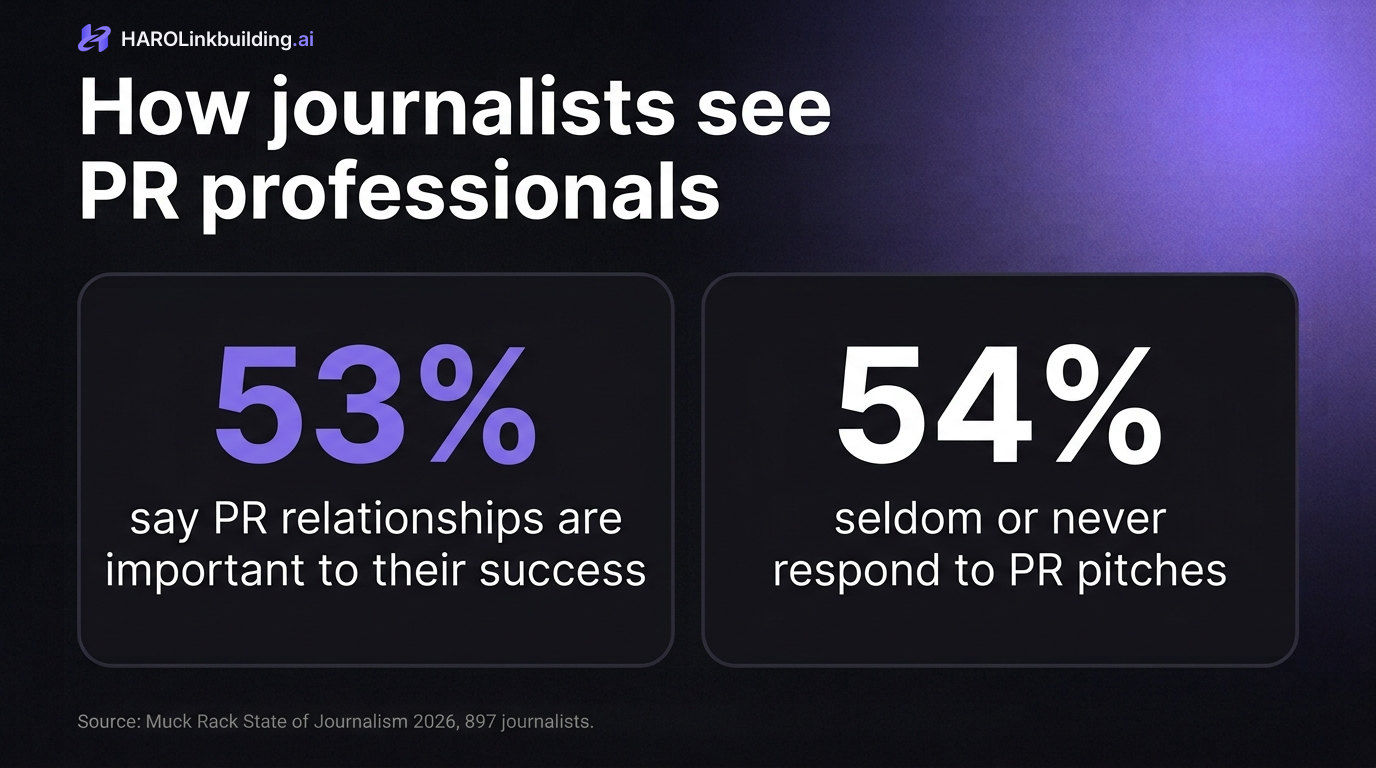
In Muck Rack's 2026 survey, 53% of journalists said relationships with PR professionals are important or very important to their success. The same survey found that 54% seldom or never respond to PR pitches, so selective, relevant pitching protects your standing for every client you represent.
How should a PR specialist set up a HARO source account?
Set the account up once, with clear ownership, before you pitch for any client.
- Register each person who will pitch at HARO's source sign-up page with their own work email. HARO's terms ask users not to share their login with anyone else, so avoid a single shared agency account.
- Write a sender line that names you, your agency and your role. Journalists should see at a glance that a PR contact is replying for a client expert.
- Create mail rules that route every digest into one shared folder. HARO's terms allow you to forward queries to others, including clients, but they forbid harvesting reporter information from the emails.
- Prepare a short bio, a credit line and contact details for each client expert. HARO's rules ask every reply to include a short bio and contact information.
- Host headshots, media kits and data files behind a shareable link. HARO strips attachments from replies automatically, and its terms suggest a service such as Dropbox instead.
HARO's source page says the daily emails carry requests "across a variety of topics and industries". We could not find a category selection setting described on HARO's public pages, so plan to do your filtering on your side.
How do you filter HARO queries across several clients?
Build a written topic map for each client before the first digest arrives. A topic map turns a long email into a short list in a few minutes. Each map should hold the following details:
- List the expert's name, title and the credentials they can prove.
- List 10 to 20 keywords that match the expert's field.
- List the topics the client will not discuss, such as litigation, pricing or competitors.
- List the outlets and audiences that matter most for the client's buyers.
- Name any other client that could compete for the same queries.
Relevance deserves the most time. Muck Rack found that 70% of journalists want a pitch to show clear relevance to their beat, and HARO's own analysis concludes that ten highly relevant pitches consistently outperform a hundred generic ones.
Score each candidate query with the scorecard below. We use a simple rule: pitch at 8 points or more, and skip any query that scores 0 on credential match or fails the conflict check.
| Criterion | 2 points | 1 point | 0 points |
|---|---|---|---|
| Topic fit | The query sits inside the client's topic map. | The query touches the map at one edge. | The link to the client is a stretch. |
| Credential match | The expert meets every stated requirement. | The query states no requirement. | The expert misses a stated requirement. |
| Evidence ready | You have a client number, case detail or firsthand example. | You have a clear, specific opinion. | You only have a general comment. |
| Approval time | The client can approve well before the deadline. | Approval is possible but tight. | Nobody can approve in time. |
| Outlet fit | The outlet reaches the client's buyers. | The outlet is credible but off-audience. | The outlet is unknown or thin. |
| Conflict check | Pass or fail. The query fails when another client competes for it or when the answer would require praising a competitor. | ||
What does a daily HARO triage workflow look like?
HARO's three send times give your day a fixed rhythm. Assign one triage lead for each digest and one account lead for each client.
Speed matters most after a journalist replies. In Cision's 2026 survey of 1,899 journalists, 52% expected a PR professional to respond within 24 hours and 30% expected a reply within an hour.
The schedule below shows the targets our editorial team recommends. Adjust the internal targets to your team size, and always put the query's own deadline first.
| When (EST) | Task | Owner | Internal target |
|---|---|---|---|
| 5:35 a.m. digest | Scan the digest, score queries and shortlist them by client | Triage lead | Shortlist ready within 60 minutes |
| Morning | Draft answers from the expert bank and send approval requests | Account lead | Requests sent within 90 minutes of the digest |
| 12:35 p.m. digest | Repeat the scan and send the morning's approved pitches | Triage lead and account lead | Approved pitches sent the same day |
| 5:35 p.m. digest | Shortlist queries and queue approvals for the next morning | Triage lead | No query with an overnight deadline left unread |
| Any time | Answer a journalist who replies to a pitch | Account lead | Reply within one business hour |
| Friday | Review the tracker, topic fit and approval delays for each client | Account lead | Weekly note to each client |
Our guide on how to respond to HARO queries covers structure and length, and our 10 HARO pitch examples show finished answers for different query types.
How do you build a client expert bank and get approvals fast?
An expert bank is a shared file that holds what you need to answer for each client without booking a new interview for every query. Muck Rack found that 58% of journalists want interview access to relevant sources and 40% want original data, so collect both at onboarding.
Fill in one sheet per expert during a 30-minute onboarding call, and update it every quarter. This template was written by our editorial team, and the placeholders show what to collect.
EXPERT PROFILE SHEET

Client: [Company]
Expert: [Full name], [Job title]
Credit line: [Full name], [Job title], [Company], [URL]
Short bio (40 words): [Role, years of experience, one credential]
Verified credentials: [Licence, degree or certification + how we checked it]
Approved topics: [Topic 1], [Topic 2], [Topic 3]
Topics to decline: [e.g. litigation, pricing, competitors]
Approved positions: [3 to 5 views the expert has already signed off]
Shareable data: [Internal figure + date + whether it may be published]
Media assets: [Link to headshot and bio]
Approver: [Name], [Email], [Phone]
Approval window: [e.g. replies within 2 business hours]
Disclosures: [Investments, partnerships or paid ties to mention]
Availability for interviews: [Days and times]
The approval step decides whether you hit deadlines. Agree in writing on who approves, how fast they reply and what happens when nobody answers in time. If the approver misses the window, skip the query. A close deadline is never a reason to send without approval.
Send each approval request in a format the client can answer in under two minutes. This example email was written by our editorial team.
Subject: Approval needed by [time]: [Outlet type] query on [topic]

Hi [Approver's name],

A journalist at [outlet name, or "an anonymous outlet"] is
looking for [type of expert] to comment on [topic].
Deadline: [date and time, with timezone].

Draft answer for [Expert's name] (under 200 words):
[Draft based on the expert bank and approved positions]

Credit line: [Full name], [Job title], [Company], [URL]

Please reply with one of these:
1. Approved as written.
2. Approved with edits (please edit the text directly).
3. Decline.

If we have no reply by [time], we will not send it.

[Your name], [Agency]
What are the attribution and ethics rules when you pitch for a client?
Everything you send carries the client's name, so the client must agree with every word. HARO's terms ask you to reply with your client's response, and the PRSA Code of Ethics asks members to be honest and accurate in all communications and to investigate the truthfulness of information released on behalf of clients.
Drafting from the expert's own notes is normal practice. Inventing an opinion the expert has never held, or inflating a credential, misleads the journalist and the reader. In advertising, FTC rules also require an expert's qualifications to in fact give them the expertise they are presented as having.
| Situation | What to do | Basis |
|---|---|---|
| The query asks for a credential the expert lacks | Skip the query or offer a client expert who holds it. | PRSA: avoid deceptive practices |
| You drafted the answer from interview notes | Send it only after the expert approves the final text. | HARO terms: reply with the client's response |
| The expert recommends a product they own, sell or are paid by | State the connection in the pitch. | FTC Endorsement Guides FAQ |
| The answer would recommend another of your clients | Disclose the relationship to the journalist or leave that client out. | PRSA: reveal the sponsors for interests represented |
| Two clients fit the same query | Apply the conflict rule agreed in your contracts and pitch one expert. | PRSA: disclose conflicts of interest |
| A published story misstates the expert's title | Ask the journalist for a correction once, politely. | PRSA: correct erroneous communications |
The FTC's guidance says a connection should be disclosed clearly when a significant minority of consumers would not expect it and it would affect how they evaluate the endorsement. We apply the same test whenever a client comments on products or companies. Offer only experts who will take part. In Cision's report, one journalist complained about being offered a CEO for an interview and then handed a junior colleague.
How should you handle anonymous queries and red flags?
Anonymous queries deserve the same care as named ones. HARO's terms say anonymous queries often come from larger outlets that hide their name to reduce spam or prevent story poaching, and they tell sources to reply to them in the usual way.
HARO also screens journalists. According to HARO, 32% of journalist requests are rejected during its approval process, and its submission guidelines require outlets to have a Domain Authority of at least 20 or 10,000 monthly visitors. Verified journalists now have profiles linked from each email, which helps you check a reporter before pitching. HARO's terms still encourage sources to do their own due diligence.
Treat these signs as red flags. HARO's submission guidelines prohibit each of these in queries, so stop and report the query when you see one:
- The journalist asks for payment, a sponsorship or a fee to publish.
- The request asks for a backlink, a link exchange or a guest post.
- The query sends you to an outside survey or data capture form.
- The request asks for testimonials or reviews.
- The query collects business leads or asks you to pitch services.
Paying for a placement also creates an SEO risk for your client. Google's spam policies list buying links for ranking purposes and exchanging goods or services for links as examples of link spam.

The last reason in that chart matters for agencies, because wrong names and outlets are easy mistakes when one person drafts for several clients. Check the journalist's name, the outlet and the client credit line before every send.
How do you track HARO placements and report results to clients?
Log every pitch in one shared tracker, with a column for the client, so each report comes from the same data. Record the query date, outlet, expert, approval time, pitch status, story URL, link target and link attribute.
Check each live story by hand. Open the page, inspect the link to your client and record its rel attribute. Google says links marked sponsored, ugc or nofollow will generally not be followed, so report those placements separately from followed links.
The Search Console Links report helps you confirm that Google has found a link, and you can export its data to a CSV file or a Google Sheet. Google notes three limits to keep in mind:
- The report shows a sample of links and is not a complete list.
- The report does not specify whether a link is marked nofollow.
- The report may still list links that publishers have since removed.
Ask each client for Search Console access at onboarding, then send a monthly report built on these measures:
| Measure | How to calculate it | Where the data comes from |
|---|---|---|
| Pitches sent | Count of approved pitches sent in the month | Your tracker |
| Selection rate | Published mentions divided by pitches sent | Your tracker |
| Followed links | Live links with no rel qualifier | Manual check of each story |
| Qualified links and mentions | Links with nofollow, sponsored or ugc, plus unlinked credits | Manual check of each story |
| Referral sessions | Visits from each story to the client site | The client's analytics |
| Average approval time | Hours from request to client reply | Your tracker |
Set expectations early, because the publisher decides whether to include a link. Report approval time too, since slow approvals are often the easiest problem for a client to fix.
When should you add other platforms to HARO?
Add a second platform when HARO consistently produces few queries that fit a client's topic map. Review this after one to two months of tracker data, and compare each platform on cost, pitch limits and team access.
- Qwoted's pricing page lists a free Basic plan with 2 pitches per month and a Team plan for agencies and PR teams with unlimited pitches.
- Featured, which also operates HARO, runs its own platform with a free plan and paid individual and team plans.
Keep the same expert bank, approval rules and tracker across every platform so results stay comparable. If your team lacks the hours to run triage every weekday, our pricing page explains our AI-assisted service, in which a person approves every pitch.
Frequently asked questions
Can a PR agency use HARO on behalf of clients?
An agency can pitch for clients. HARO's terms cover users who represent a person or entity, and they ask agencies to reply with the client's actual response instead of a note saying the client can speak about the topic.
Is HARO free for PR professionals?
HARO's About page says the service is free for both journalists and sources, and it earns revenue from newsletter advertising.
What time do HARO emails arrive?
HARO's terms say sources receive three emails a day, Monday through Friday, at 5:35 a.m., 12:35 p.m. and 5:35 p.m. EST.
Can my PR team share one HARO login?
HARO's terms ask users not to share their login with anyone else, so give each team member who pitches their own account.
Can I attach a client's headshot or media kit to a HARO reply?
HARO strips attachments from replies automatically, and its terms suggest sharing supporting files through a link from a service such as Dropbox.
How quickly should I reply when a journalist responds?
Reply as fast as you can. In Cision's 2026 State of the Media survey, 52% of journalists expected a PR professional to respond within 24 hours and 30% expected a reply within an hour.
Does Search Console show whether a HARO link is nofollow?
Google says the Search Console Links report does not specify whether a link is marked nofollow, so inspect each live story to record the link attribute.