

Quick answer
The main HARO alternatives in 2026 are Connectively, Featured, Qwoted, SourceBottle, ResponseSource and ProfNet, plus the free #JournoRequest hashtag on X and Bluesky. Muck Rack is a journalist database and has no public request feed. HARO itself still runs: Featured.com bought it in April 2025, and it sends three free emails each weekday. Most teams keep HARO and add one platform that fits their region, budget and topics, then compare results after a few months.
Key facts about HARO alternatives
- HARO is free and sends sources three emails a day, Monday through Friday, at 5:35 a.m., 12:35 p.m. and 5:35 p.m. EST, according to HARO's terms.
- Featured owns both HARO and Connectively. Connectively passed 100,000 users after Featured revived it in 2026, according to a June 9, 2026 press release.
- Qwoted's free Basic plan includes 2 pitches per month with a 2-hour delivery delay, according to Qwoted's pricing page.
- 66% of journalists rely most often on PR-provided content to find story ideas or leads, and 45% name social media, according to Cision's 2026 State of the Media Report.
- 14% of journalists received more than 20 PR pitches on their last normal workday, according to Muck Rack's State of Journalism 2026.
What counts as a HARO alternative?
A HARO alternative is any service or channel that shows you what journalists are looking for before you pitch. The journalist describes the story and the expert they need, and you decide whether you fit. This reverses cold outreach, where you guess what a journalist might want.
The options fall into four groups. Each group asks for a different amount of time and money.
- Request platforms collect journalist queries and send them to sources. HARO, Connectively, Qwoted, SourceBottle, ResponseSource and ProfNet belong here.
- AI assistants scan several request feeds for you. Featured now works this way.
- Free social channels carry public requests. The #JournoRequest hashtag on X and Bluesky is the best known.
- Media databases help you find and pitch journalists yourself. Muck Rack is the example in this guide.
Requests matter because journalists still lean on PR material. In Cision's 2026 survey of 1,899 journalists in 19 markets, PR-provided content was the resource journalists named most often for finding story ideas or leads.

How does HARO work in 2026?
HARO is still an option, and it is free. Cision rebranded the service as Connectively in 2024 and later discontinued it. Featured has since revived the Connectively name for a separate platform, covered below. Cision announced the sale of HARO to Featured.com on April 15, 2025, and Featured says it sent its first HARO edition on April 22, 2025.
The relaunched service runs at helpareporter.com. HARO says it is free for journalists and sources and earns its revenue from newsletter advertising. A journalist submits a query, sources receive up to three digests per weekday, and sources pitch by email. When a journalist picks a source, the journalist makes contact directly for the full quote or an interview.
HARO's terms say the emails carry requests from reporters and media outlets worldwide. Its About page lists AI-generated content detection, masked emails, community reporting and lifetime bans for policy violations as trust and safety measures. For the full process, read our guide on how to get backlinks through HARO. PR teams that pitch for clients can use our guide on how to use HARO as a PR specialist.
How do the main HARO alternatives compare?
The table below summarises what each platform's own pages said on 13 November 2026. "Not stated" means we could not find a region on the official site. Pricing on these pages changes, and Featured and Connectively both reorganised their products in mid-2026, so treat every price as a snapshot.
| Platform | Best for | Cost model | Region | How requests arrive |
|---|---|---|---|---|
| HARO | Any source who wants a free daily feed | Free, funded by newsletter ads | Requests from outlets worldwide | Three emails each weekday |
| Connectively | Experts who answer publisher questions and write bylined articles | Free plan with 3 answers a month; paid plans from $19 a month | Not stated | In-platform question feed and keyword email alerts |
| Featured | Teams that want an AI assistant to scan several feeds | Free plan; paid plans from $39 a month, or $29 a month billed annually | Not stated | Chat and workflows that pull requests from HARO, Connectively, Substack, X and LinkedIn |
| Qwoted | Experts and agencies who want to pitch inside one platform | Free plan with 2 pitches a month; Pro at $149.99 a month; Team on request | Not stated | In-platform feed, a daily opportunities email and real-time alerts |
| SourceBottle | Experts who want coverage in its listed markets | Free call-outs; optional paid pitching service from $25 per pitch | Australia, New Zealand, Singapore, UK, Ireland and North America | Call-outs sent to your inbox |
| ResponseSource | PR teams that target UK media | Annual subscription from £625 per category, excluding VAT | UK | Emailed requests, filtered by category |
| ProfNet | Teams that want a paid lead service run by Cision | Paid subscription; price not published | Not stated | Leads matched to the preferences you set |
| #JournoRequest | Anyone who can check social feeds every day | Free | Wherever journalists post | Public posts on X and Bluesky |
| Muck Rack | Teams that research and pitch journalists directly | Custom pricing for PR users; free for journalists | Not stated | No request feed; you search the database |
What does each HARO alternative offer?
Each summary below uses the platform's own pages. We note where a page left a detail out.
Connectively
Connectively is the platform where experts answer questions from publishers. Featured migrated its earlier expert platform to the Connectively name in 2026, and its press release says experts browse opportunities, filter by topic and outlet, and submit pitches inside the platform. The same release says it runs alongside HARO and that Featured owns both.
Connectively's pricing page lists a free plan with 3 answers and 1 bylined article per month, plus 3 daily keyword alerts. Paid plans are Lite at $19 a month, Pro at $49 and Business at $99, with lower monthly rates on annual billing. Pro includes unlimited answers, subject to abuse guardrails.
Featured
Featured relaunched on June 2, 2026 as what it calls an AI co-pilot for PR. Its journalist requests page says you describe your expertise, and the assistant finds matching requests from HARO, Connectively, Substack, X and LinkedIn, then drafts a response for you to review and send.
Featured's pricing page lists a free plan for exploring 2 to 3 media opportunities per week. Individual plans run from Lite at $39 a month to Pro+ at $299 a month, and team plans cover up to 25 seats. Plans are sized by AI usage, so the page gives no fixed number of pitches per plan.
Terkel no longer exists as a separate product. Featured's About page says Terkel was the company's name from 2022 to 2023, and terkel.io now redirects to featured.com.
Qwoted
Qwoted connects sources with journalists, editors and podcasters who post calls for experts. Its help centre says your feed shows calls matched to your expertise, alerts also arrive by email, and each pitch goes directly to the journalist or producer who posted the request.
The free Basic plan allows 2 pitches a month, delivered after a 2-hour delay. Pro costs $149.99 a month or $1,188 a year and includes 35 pitches a month with instant delivery. The Team plan for agencies and PR teams offers unlimited pitches at a price you request from Qwoted.
SourceBottle
SourceBottle was founded in Australia in 2009. It says it covers Australia, New Zealand, Singapore, the United Kingdom, Ireland and North America, and connects more than 65,000 experts, brands, PR professionals and organisations with media.
The free plan includes an expert profile, a directory listing and media call-outs delivered to your inbox. Every plan lets you respond to unlimited call-outs. The paid tiers add a pitching service run by SourceBottle's team, priced at $25 per pitch, $65 a month or $130 a month for agencies. The page does not name the currency.
ResponseSource
ResponseSource's Journalist Enquiry Service emails subscribers requests from UK journalists across national, regional, trade and consumer media. The company says a quality control team reviews each request, and filters let you narrow the feed by request, media and sender type.
It is a paid service. ResponseSource's pricing page lists 25 categories on an annual subscription, starting from £625 per category, excluding VAT. A free trial is available on request.
ProfNet
ProfNet is a Cision company that connects journalists with expert sources. Experts subscribe, set their preferences and receive media leads. ProfNet says journalists and bloggers send thousands of story leads to its users every month.
Journalists use ProfNet for free. Experts pay a subscription, and the site asks you to contact the company for a price.
#JournoRequest on X and Bluesky
Journalists post public requests for sources with the #JournoRequest hashtag. It costs nothing, and anyone can search it. The trade-off is that no platform vets these posts, so check the journalist's profile and outlet before you share a quote or contact details.
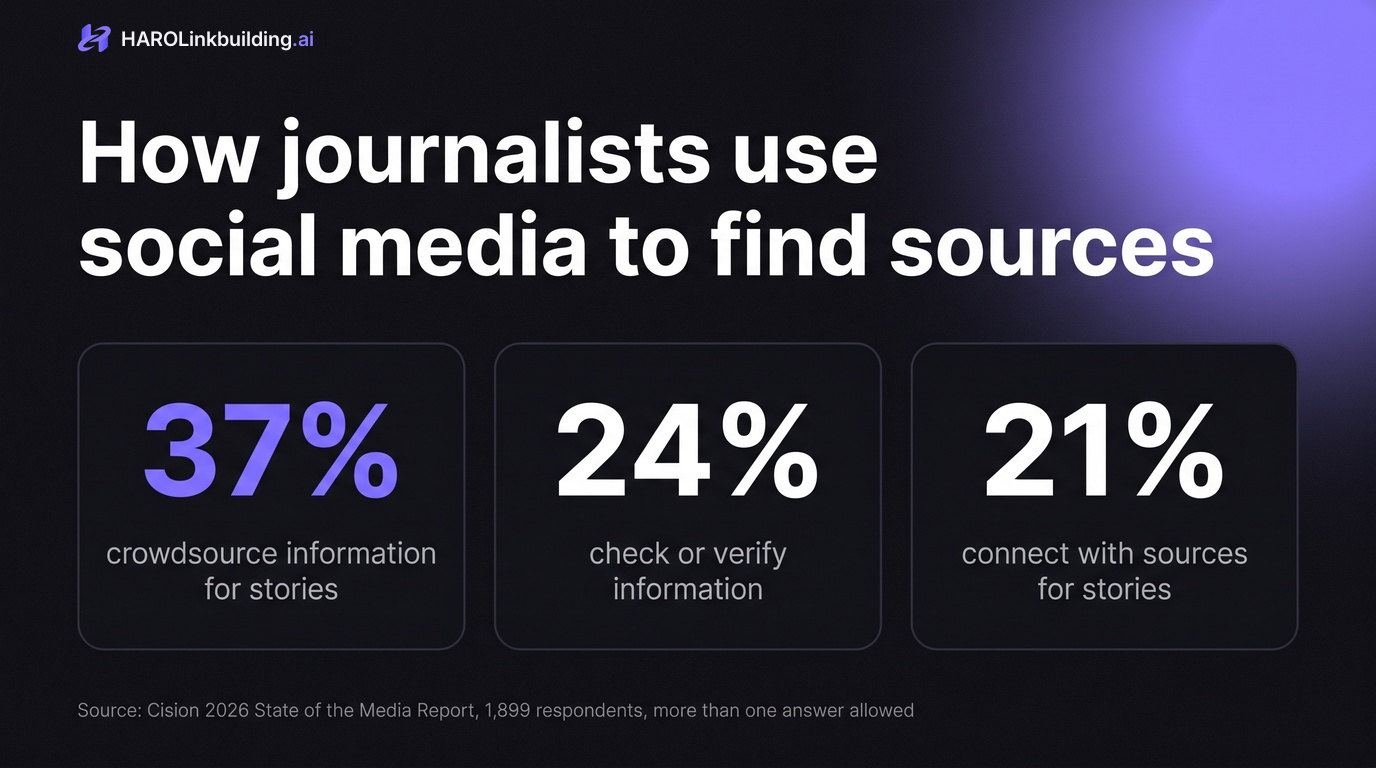
Social media still plays a part in sourcing. In Cision's survey, 37% of journalists used social media for work to crowdsource information for stories and 21% used it to connect with sources.
Journalists are spreading out across networks, so search more than one. Muck Rack found that the share of journalists who name X as their most valuable social platform fell to 17% in 2026, from 36% in 2024. The share spending more time on Bluesky fell from 38% to 24% over the past year.
Muck Rack
Muck Rack is a media database and monitoring tool. Its pricing page lists journalist and outlet search, media lists, pitching tools and monitoring alerts, with custom pricing for PR users. Journalists never pay to use it.
The pricing page lists no journalist request feed for sources. Muck Rack suits teams that already know which journalists they want to reach and need to research them before pitching.
Which HARO alternatives are free?
Several options cost nothing, but the free tiers differ a lot in volume. Use this table to see what a free account gives you.
| Option | What the free tier includes | Main limit |
|---|---|---|
| HARO | Three request emails each weekday | You read and filter every digest yourself. |
| Connectively | 3 answers, 1 bylined article and 3 daily keyword alerts per month | Three answers run out quickly if you pitch weekly. |
| Featured | AI matching for 2 to 3 media opportunities per week | Usage is capped by a daily allowance. |
| Qwoted | 2 pitches a month and a daily opportunities email | Free pitches reach the journalist after a 2-hour delay. |
| SourceBottle | Unlimited call-out responses and up to 10 profile keywords | The outlets shown on its site are mostly Australian. |
| #JournoRequest | Every public post with the hashtag | No vetting, so you verify each journalist yourself. |
ResponseSource, ProfNet and Muck Rack have no free plan for sources on their official pages.
How do you choose the right HARO alternative?
Start with what you already have. HARO costs nothing, so most teams can keep it as a baseline and test one additional platform at a time. These steps are our editorial team's recommendations.
- Match the platform to your audience's region. ResponseSource focuses on UK media, and SourceBottle lists Australia, New Zealand and other markets.
- Count the pitches you can realistically write each month. A free plan with 2 or 3 pitches suits a test, while a team pitching every day will need a paid tier or HARO's open feed.
- Decide where your team prefers to work. Requests from HARO, ResponseSource and SourceBottle arrive by email, while Qwoted and Connectively ask you to pitch inside their platforms.
- Check the expert's time before you pay. A platform only helps when a named expert can answer requests before the deadline.
- Run each new platform for 90 days and log every pitch in the same tracker as HARO.
- Compare the cost per published placement, then keep, upgrade or cancel.
Request feeds also help with inbox overload. A journalist who posts a request has already asked for help, while a cold pitch competes with everything else in the inbox.

This table matches common situations to a starting point. It reflects the official details above and our own judgement.
| Your situation | Where to start |
|---|---|
| No budget and one expert | HARO plus #JournoRequest searches |
| Small budget and time to pitch inside a platform | HARO plus the free plan on Qwoted or Connectively |
| Limited time to read digests | An AI assistant such as Featured, with a person approving each pitch |
| Clients who want UK national or trade coverage | ResponseSource in the categories that match each client |
| Clients in Australia or New Zealand | SourceBottle |
| A target list of named journalists | A media database such as Muck Rack |
Use one tracker for every platform so you can compare them fairly. Here is a template written by our editorial team that you can adapt:
PLATFORM TEST LOG: [Platform name]

Test period:        [Start date] to [End date]
Plan and cost:      [Free / plan name and monthly cost]
Expert(s):          [Full name, job title]

For each request:
- Date seen:        [Date]
- Outlet:           [Outlet name or "anonymous"]
- Topic fit:        [Yes / No]
- Pitched:          [Yes / No, and reason if no]
- Result:           [Published / No reply / Declined]
- Story URL:        [URL]
- Link type:        [Followed / Qualified / Mention only / None]

Monthly totals:
- Requests that fit:      [N]
- Pitches sent:           [N]
- Placements published:   [N]
- Cost per placement:     [Plan cost divided by placements]
Good platforms still fail when the answers are weak. Our guides on how to respond to HARO queries and 10 HARO pitch examples apply to every request feed in this list. Before you add more platforms, read the HARO link building mistakes to avoid, and see how HARO fits an SEO strategy.
Which platforms did we leave out?
We left out three names that often appear on HARO alternative lists. Two had no official page we could check, and one no longer exists as a separate product.
- Source of Sources (SOS): its website returned an "Index file not found" page when we checked, so we could not confirm how it works today.
- Help a B2B Writer: its domain now redirects to a site called MentionMatch, which describes itself as launching soon and does not state its pricing.
- Terkel: Featured says Terkel was its own company name from 2022 to 2023, so it is covered under Featured above.
Every platform here still needs the same daily work: reading requests, matching them to an expert and writing a quotable answer quickly. If your team lacks the hours, our pricing page explains our AI-assisted service, in which a person approves every pitch.
Frequently asked questions
Is HARO still running in 2026?
HARO is still running. Cision sold HARO to Featured.com on April 15, 2025, and HARO now runs at helpareporter.com as a free service that sends sources three emails each weekday.
What is the best free HARO alternative?
It depends on your volume. Qwoted's free plan includes 2 pitches a month, Connectively's free plan includes 3 answers a month, SourceBottle sends free call-outs to your inbox, and the #JournoRequest hashtag on X and Bluesky costs nothing to search.
Is Connectively still available?
Connectively is available again. It was discontinued in 2024, and Featured revived it in 2026. A June 9, 2026 press release says it passed 100,000 users and runs alongside HARO, which Featured also owns.
What happened to Terkel?
Featured says Terkel was the company's name from 2022 to 2023 and is no longer used as a product name. The terkel.io domain now redirects to featured.com.
Is Muck Rack a HARO alternative?
Muck Rack is a media database for finding and pitching journalists, with custom pricing for PR users. Its pricing page lists no journalist request feed for sources, so it suits teams that pitch named journalists directly.
Which HARO alternative suits UK media?
ResponseSource sends requests from UK journalists by email. Its pricing page lists an annual subscription starting from £625 per category, excluding VAT.
Do journalist request platforms guarantee a backlink?
These platforms do not guarantee a backlink. HARO says a published source is credited, often with a link back to their website, and the publication decides whether to include a link.