

Quick answer
AI link building means using artificial intelligence to support the work of earning links: researching prospects, drafting pitches, matching experts to journalist requests and measuring results. Most PR professionals now use generative AI, mainly for editing, research and writing. Google allows appropriate use of AI, but its spam policies cover automated link creation and mass-produced AI pages. At least one request platform, Qwoted, prohibits AI-written pitches. The safe model uses AI for speed and a named person for the facts, the approval and every message sent.
Key facts about AI link building
- 80% of PR professionals say they already use generative AI in their workflow, according to Muck Rack's State of PR 2026, which drew 971 usable responses in May and June 2026.
- Google says "Appropriate use of AI or automation is not against our guidelines" in its guidance about AI-generated content.
- Google's spam policies list "Using automated programs or services to create links to your site" as an example of link spam.
- Qwoted's help center states that using AI to write your pitches is against its Terms & Conditions.
- In a study led by public service broadcasters, 45% of AI assistant answers to news questions had at least one significant issue, according to the European Broadcasting Union.
- 55% of PR professionals say they secure coverage in high-authority publications to improve their visibility in AI-generated responses, in the same Muck Rack survey.
What is AI link building?
The term covers two very different practices. The first uses AI to help people do the work of earning editorial links, such as finding the right outlets, reading journalist requests and preparing a draft for an expert to check. The second uses automated tools to place links or publish pages at scale.
Google's spam policies name the second practice directly, so this guide covers only the first. If you are new to earning links through journalist requests, start with our step-by-step guide to getting backlinks through HARO, which covers the full pitching process.
What does AI change at each stage of link acquisition?
Adoption is already high in PR. Muck Rack's State of AI in PR 2026, a survey of 564 PR professionals in December 2025, found that 76% use generative AI. Its larger State of PR 2026 survey in May and June 2026 put the figure at 80%. The two surveys used different samples, so read them as a range.
The same AI report asked people who already use AI what they use it for. Writing and research tasks lead by a wide margin.
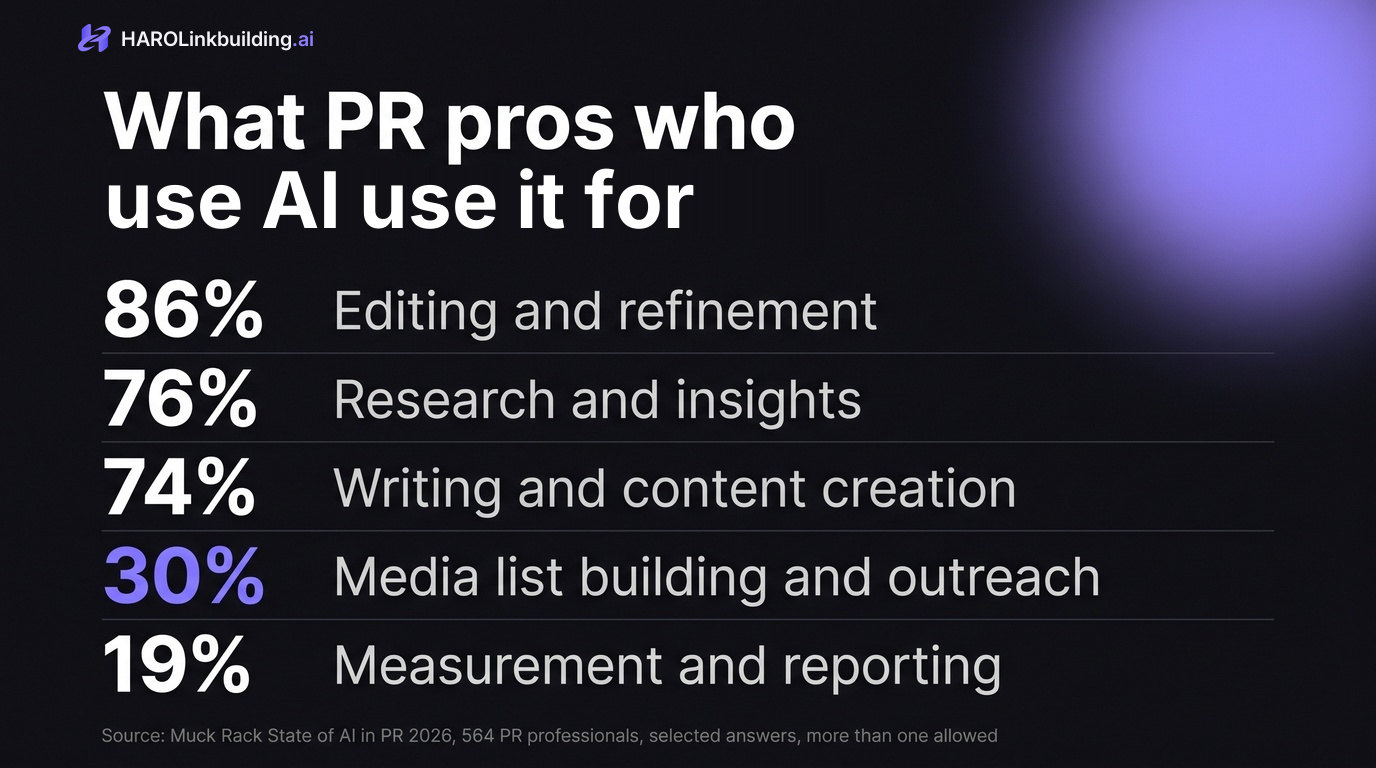
The chart shows a gap. AI use is highest for editing, research and writing, and it drops for outreach and measurement, which are the stages closest to earning a link. Each stage carries its own risks.
Research and prospecting
AI can summarize an outlet's recent coverage, group journalist requests by topic and suggest publications that cover your field. That can cut reading time. It does not replace checking, because AI tools still get sources wrong.
The European Broadcasting Union and the BBC coordinated a study in which journalists from 22 public service media organizations evaluated more than 3,000 answers from ChatGPT, Copilot, Gemini and Perplexity. They found that 31% of responses had serious sourcing problems and 20% contained major accuracy issues. The study tested news questions, so treat it as a warning for any research task. Open every outlet, author page and claim yourself before it goes into a prospect list.
Drafting pitches and outreach
AI can fit an expert's notes to a request's word limit, order the points and tidy the grammar. The expert still has to supply the facts. In Muck Rack's AI report, 98% of PR professionals said they always or often edit text that AI generates, and 45% said they have to edit most of it.
Platform rules matter more here than at any other stage. Some request services allow AI help and others prohibit it, as the section on platform responses below explains.
Matching experts to journalist requests
Request volume is the main reason teams turn to AI. HARO sends up to three email digests per day, Monday through Friday, according to its About page, and Qwoted says its feed surfaces Calls for Experts matched to your expertise. AI can screen each request against an expert's topic list and flag the likely fits.
A person should confirm every match. The expert has to meet every requirement in the request, and a near miss wastes the journalist's time. Our guide on how to use HARO as a PR specialist sets out a daily triage routine, and our review of the best HARO alternatives compares the main request platforms.
Measurement
AI can sort a placement log, check live stories for links and summarize results by month. Only 19% of AI users in the Muck Rack report use it for measurement and reporting. The judgment calls stay with a person: whether a placement counts, which pages the coverage supports and where to spend next month's effort.
What do Google's rules say about AI and link building?
Google does not ban AI-assisted work. Its 2023 guidance says it rewards high-quality content however it is produced. Its rules focus on purpose and value: content or links made mainly to manipulate rankings fall under its spam policies, whatever tool produced them.
| Google document | What it says | What it means for AI link building |
|---|---|---|
| Guidance about AI-generated content (February 8, 2023) | "Appropriate use of AI or automation is not against our guidelines." | Using AI to research or draft is allowed when the result helps people. |
| Spam policies: link spam | Lists "Using automated programs or services to create links to your site" as link spam. | Tools that post comments, create profiles or place links automatically put your site at risk. |
| Spam policies: scaled content abuse | Lists "Using generative AI tools or other similar tools to generate many pages without adding value for users". | Mass-produced guest posts or link-bait pages written by AI fall into this example. |
| Guidance on using generative AI content | "It is critical to manually factcheck and review all AI-generated content for accuracy and trustworthiness before publishing." | Any research page or data asset you build to attract links needs a human fact check, including its title, description and alt text. |
| Qualify outbound links | Paid placements should carry rel="sponsored", and "Links marked with these rel attributes will generally not be followed." | AI changes nothing here. A paid link needs a qualifier, and an earned link depends on the publisher's markup. |
The same generative AI guidance says AI "can be particularly useful when researching a topic, and to add structure to original content." That description fits the assisted model in this guide. For a fuller look at nofollow, sponsored and ugc links, see our guide to how HARO link building supports your SEO strategy.
How do journalists and request platforms respond to AI-written pitches?
Responses are getting stricter, and they differ by platform. Check the rules of every service you use before AI touches a pitch.
Qwoted prohibits AI-written pitches
Qwoted's help center article on AI, dated September 22, 2026, says AI-written pitches break its Terms & Conditions. It warns that even brainstorming, grammar help or light rewording can trigger detection, and it advises sources to "Stick to basic spellcheck." Accounts can be temporarily disabled when AI use appears highly likely, and the article says continued violations may lead to permanent removal.
Enforcement is active. Press Gazette reported on July 27, 2026 that Qwoted has banned hundreds of PR agencies, executives and experts who appear not to exist, who use AI to write or who comment outside their expertise. Qwoted's head of user experience told Press Gazette the platform deals with upwards of 15 violations per day. Qwoted combines a human vetting team with technology that flags accounts for signals such as pitching a large number of times per day.
Publishers are deleting stories built on dubious experts
Press Gazette compiled a dossier of more than 100 articles that relied on apparently fake or dubious experts, and publishers deleted or amended stories after its April 2025 investigation. Yahoo News deleted or amended more than a dozen articles, and Reach began removing articles across its titles. The UK press regulator IPSO told publishers to be alert to the potential of AI to spread misinformation.
Press Gazette's July 2026 report describes fake experts as "mainly deployed as a dubious SEO tactic, driving links from reputable newsbrands". That is the publication's own assessment. For link builders, the lesson is direct: invented or AI-generated expertise can cost the link, the story and the relationship with the outlet.
Editors are changing how they accept pitches
Some editors now restrict how pitches arrive. Nieman Lab reported in August 2026 that The Food Section, a newsletter covering food in the American South, would take story pitches only by phone. Its founder estimated that roughly one in four recent pitches were wholly AI-made. Those were freelance story pitches, so the estimate says nothing direct about expert pitches. It does show how quickly some editors are changing their rules.
HARO lists AI-generated content detection among its trust and safety measures. We covered HARO's own selection data and Cision's survey of journalist attitudes to AI pitches in our guide to HARO link building mistakes.
Where does human review stay essential?
AI agents can now carry out tasks with little human input, but PR professionals are cautious about letting them act alone. In Muck Rack's AI report, only 12% of AI users said they use AI agents in their work. Nine in ten said they would not be comfortable letting an agent send messages or publish updates without human review.
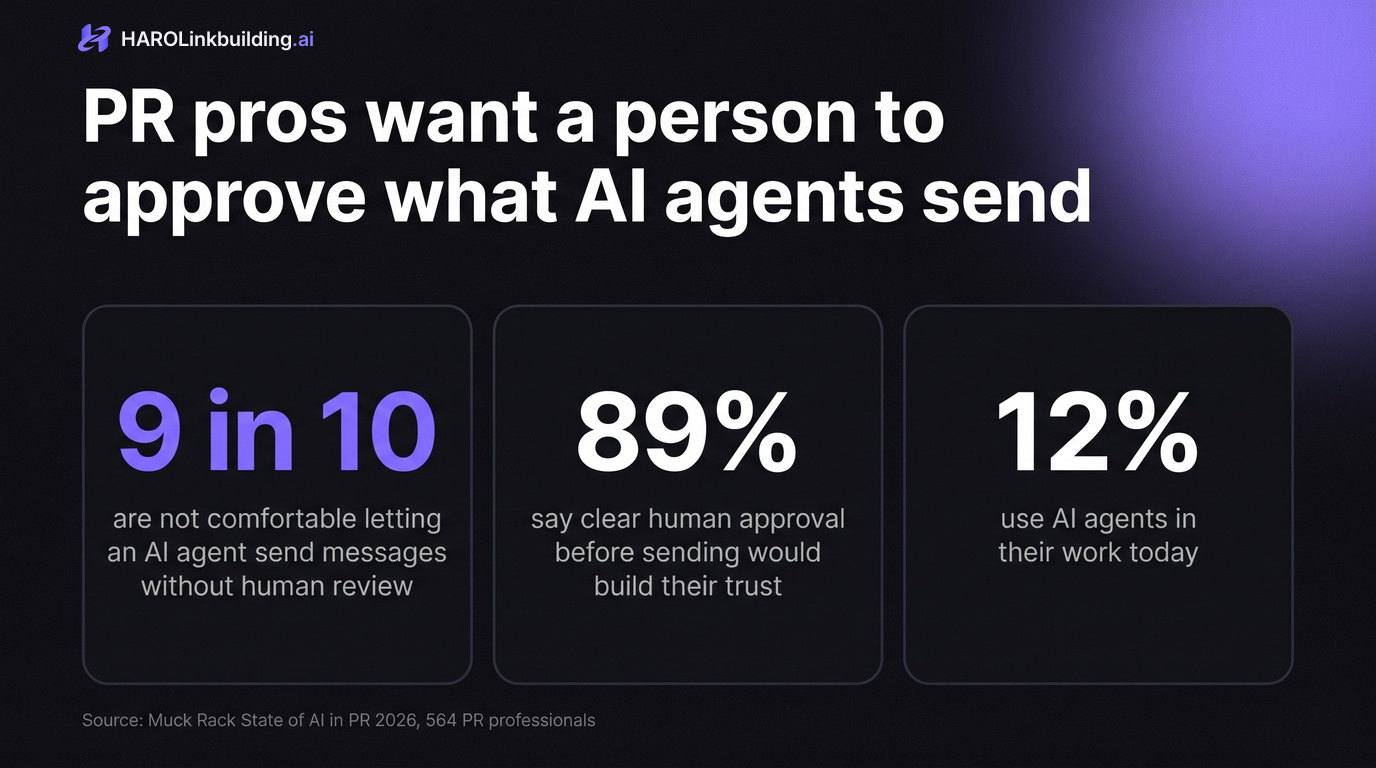
When asked what would make them trust AI agents more, 89% chose clear human approval before publishing or sending. That matches what Google asks for content and what Qwoted enforces for pitches. Use this split of work as a starting point.
| Task | Where AI helps | What a person must decide |
|---|---|---|
| Prospect research | Summarizes an outlet's recent coverage and groups topics. | Whether the outlet is real, relevant and worth a pitch. |
| Request matching | Screens request digests against each expert's topic list. | Whether the expert meets every requirement in the request. |
| Platform rules | Flags the rules stated in a request or platform policy. | Whether AI may touch the pitch at all on that platform. |
| Pitch drafting | Fits the expert's notes to the word limit and structure, where the platform allows it. | The facts, numbers, opinions and final wording under the expert's name. |
| Sending and replies | Reminds the team of deadlines and open threads. | Whether to send, what to say and how to answer the journalist. |
| Link checks | Checks live stories for a link and its rel value. | How to record the placement and whether to follow up. |
| Reporting | Summarizes the placement log by month and target page. | What the results mean and where to focus next. |
What does a simple AI link building workflow look like?
This seven-step workflow keeps AI on the preparation work and a person on every decision that reaches a journalist.
- Write down the AI rules for each platform you use. Where a platform prohibits AI-written pitches, as Qwoted does, the expert writes the pitch.
- Build a topic list for each expert, with their credentials and the pages they can offer as a source.
- Let AI screen requests and prospect lists against the topic lists, and have a person confirm each match.
- Collect the expert's raw input in their own words: one number, one example and one opinion that answer the request.
- Where the platform allows it, use AI to fit that input to the requested format. The expert then checks every fact and approves the final text.
- Have a person send the pitch, follow the request's instructions and handle any reply.
- Log each result, check the live story for a link and review the log every month.
A short checklist keeps step 5 consistent across the team. Here is an example written by our editorial team:
AI REVIEW CHECKLIST (example by our editorial team)

Request: [Outlet type] query on [topic]
Platform: [Platform name]
Platform AI rule: [Allowed / Prohibited / Not stated]
Expert: [Your name], [Title], [Company]

[ ] The expert meets every requirement in the request.
[ ] Every number has a source the expert can name.
[ ] Every example comes from the expert's own work.
[ ] No outlet, person or study in the text is invented.
[ ] The pitch follows the requested length and format.
[ ] The expert approved the final text on [date].
[ ] A person sends the pitch from their own account.
How does AI search change which links and mentions matter?
Google says ordinary SEO still applies to its AI features. Its page on AI features and your website states: "There are no additional requirements to appear in AI Overviews or AI Mode, nor other special optimizations necessary." It also says both features may use a "query fan-out" technique and that its models identify supporting web pages while they build a response.
The audience for these features is large. In Alphabet's Q2 2026 earnings remarks, Sundar Pichai said AI Mode has surpassed 1 billion monthly active users and that Google is "now sending billions of clicks to websites every week through AI features in Search." These are Google's own figures. Independent research on clicks is less positive, and our SEO strategy guide covers what that research found.
PR teams are adjusting. In Muck Rack's State of PR 2026, the most common tactic for improving visibility in AI-generated responses was securing coverage in high-authority publications, chosen by 55%. Measurement has not caught up yet.
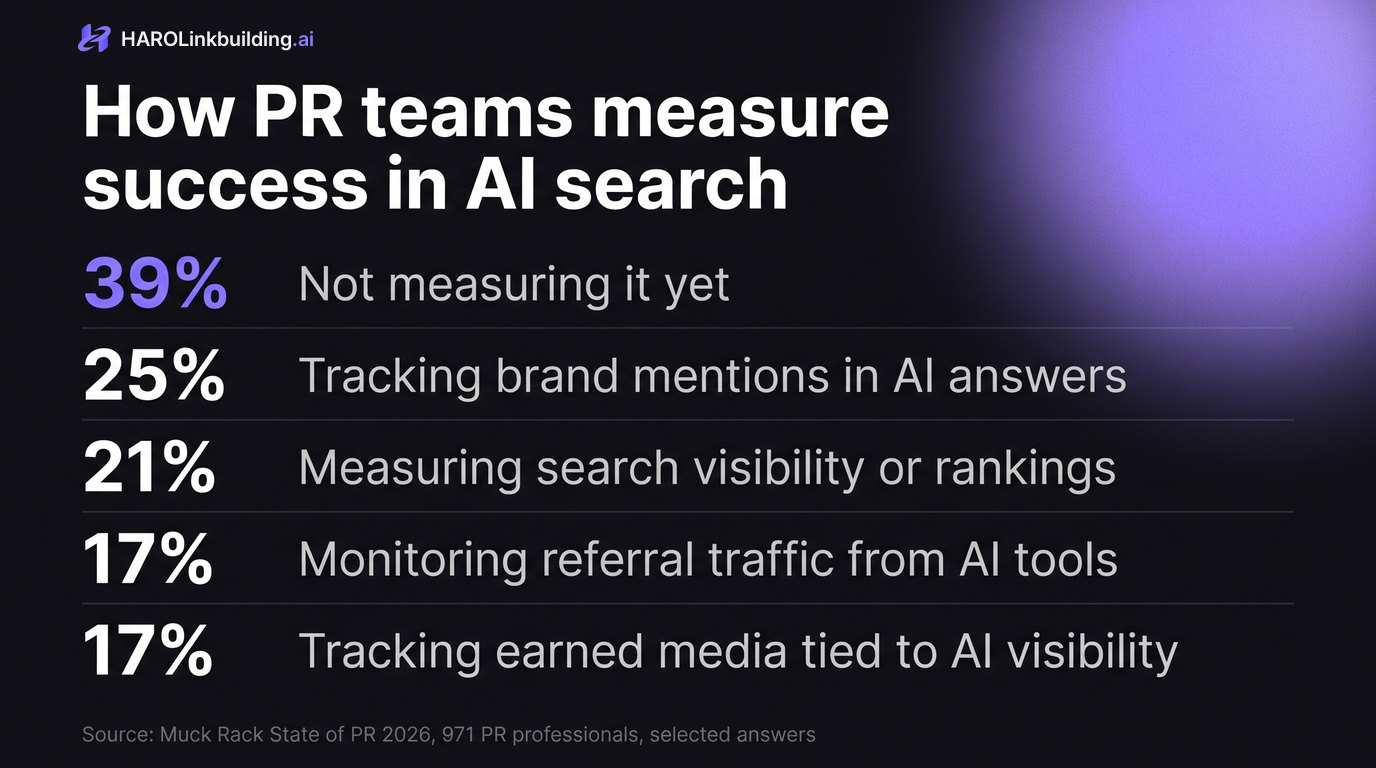
This data suggests a practical shift. A named mention in a trusted publication can now reach people through an AI answer even when nobody clicks the link. We have found no public evidence that a single placement changes what an AI assistant says about a brand, so treat mentions as a result worth tracking and keep links as a separate line in your report.
Google says sites that appear in AI features are counted in the overall search traffic in Search Console, so you will not see them as a separate line. Pair that data with a monthly check of how AI assistants describe your brand, and record the questions you ask so the check can be repeated.
Your team can run this workflow in-house or hand the daily request review to a service. We have a stake in this choice: our service uses an AI agent to read requests and prepare drafts, and a person approves every pitch before it is sent. You can compare plans on our pricing page.
Frequently asked questions
Is AI link building against Google's guidelines?
Using AI to help is allowed. Google says appropriate use of AI or automation is not against its guidelines, but its spam policies list using automated programs or services to create links, and using generative AI to produce many pages without adding value for users.
Can I use AI to write pitches for journalist request platforms?
Check each platform's rules first. Qwoted says using AI to write pitches is against its Terms & Conditions, and HARO lists AI-generated content detection among its trust and safety measures.
Do request platforms ban accounts for AI-written pitches?
Qwoted says continued violations of its AI rule may lead to permanent removal from the platform. Press Gazette reported in July 2026 that Qwoted has banned hundreds of PR agencies, executives and experts.
Can an AI agent send outreach emails for me?
Most PR professionals do not trust agents to act alone yet. In Muck Rack's State of AI in PR 2026, nine in ten PR professionals said they would not be comfortable letting an AI agent send messages without human review.
Is AI research reliable enough for link prospecting?
Use it as a starting point and verify every result. In an EBU and BBC study, 45% of AI assistant answers to news questions had at least one significant issue, and 31% had serious sourcing problems.
Do links and mentions matter for AI search?
Google says there are no additional requirements to appear in AI Overviews or AI Mode, so normal SEO fundamentals apply. We have found no public evidence that one placement changes what an AI assistant says about a brand, so track mentions and links separately.
How do PR teams measure visibility in AI answers?
Many do not measure it yet. In Muck Rack's State of PR 2026, 39% said they are not currently measuring success related to generative engine optimization (GEO), and 25% track brand mentions in AI-generated responses.