

Quick answer
To get high-quality backlinks, give relevant publications a reason to link to you on their own judgment. The most dependable methods are expert commentary for journalists who request sources, original data, useful resources, digital PR, honest partnerships, and reclaiming mentions and broken links you already earned. Google lists excessive link exchanges and paid links that pass ranking credit as link spam. A smaller number of editorial links from sites your buyers read is the safer goal.
Key facts about high-quality backlinks
- Google defines link spam as creating links "primarily for the purpose of manipulating search rankings", according to its spam policies.
- Google's examples of link spam include buying or selling links for ranking purposes and "Excessive link exchanges ("Link to me and I'll link to you")".
- Google says paid links for advertising do not violate its policies when they carry a rel="nofollow" or rel="sponsored" attribute.
- 54% of journalists say they seldom or never respond to PR pitches, according to Muck Rack's State of Journalism 2026.
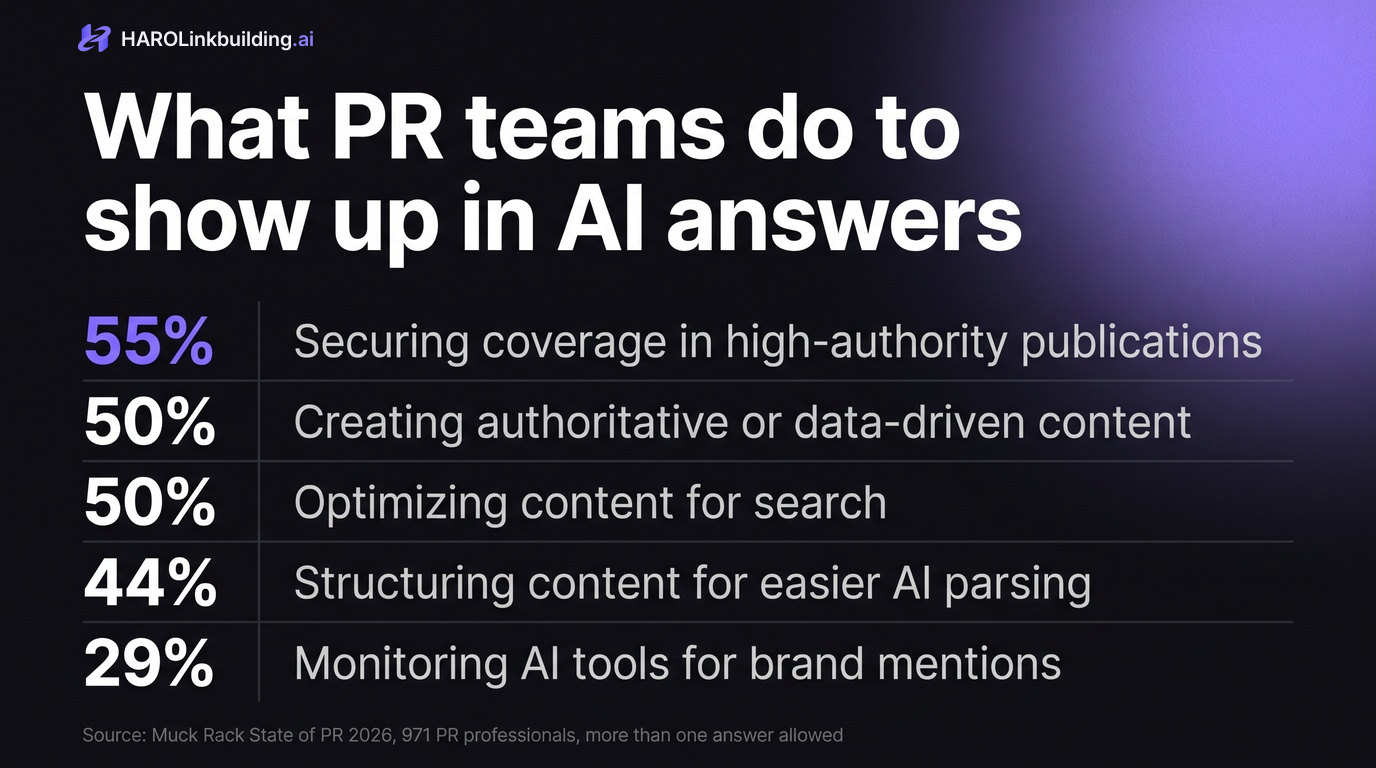
- 55% of PR professionals say they secure coverage in high-authority publications to improve visibility in AI-generated responses, according to Muck Rack's State of PR 2026.
- Data or research is the resource journalists most want more of from PR professionals, at 47% in Cision's 2026 State of the Media Report.
What makes a backlink high quality?
A high-quality backlink is a link that an editor or author chose to place because it helps their readers. Google says it uses links "as a signal when determining the relevancy of pages". A link therefore carries the most weight when the page around it is relevant to yours and the decision to link was made freely.
Judge each link by the five traits below before you look at any third-party authority score.
| Trait | What to check | Warning sign |
|---|---|---|
| Relevance | The page covers your topic, and its readers could use your product or your expertise. | The site publishes on every subject, from casinos to pet food. |
| Editorial choice | An editor or author decided to link because the source helps the story. | The link was bought, traded or written into a contract. |
| Real audience | The site has named authors, recent articles and readers who engage with them. | The site has no authors, no contact details and posts that exist only to hold links. |
| Placement in content | The link sits in the body text, next to a sentence that explains why it is there. | The link sits in a footer, a sidebar or a list of unrelated links. |
| Natural anchor text | The anchor describes the page it points to, often your brand or the title of your resource. | The anchor repeats an exact commercial keyword that you requested. |
Placement matters because Google reads the text around a link as well as the link itself. Its link best practices say "the words before and after links matter" and describe good anchor text as "descriptive, reasonably concise, and relevant to the page that it's on". Our guide to editorial backlinks covers the editorial choice trait in more depth.
What does Google say about link exchanges and paid links?
Google's spam policies define link spam as "the practice of creating links to or from a site primarily for the purpose of manipulating search rankings." The page then lists examples. The ones that matter most for B2B teams are these:
- Exchanging money, goods or services for links, including a free product sent in exchange for a review with a link.
- Excessive link exchanges, and partner pages that exist only for cross-linking.
- Using automated programs or services to create links to your site.
- Requiring a link in a contract or terms of service without letting the other site qualify it.
- Guest posts, advertorials and press releases with links that use optimized anchor text.
- Widely distributed links in the footers or templates of other sites.
Paying for visibility is still allowed. Google says buying and selling links "is a normal part of the economy of the web for advertising and sponsorship purposes," as long as the link is qualified with rel="nofollow" or rel="sponsored". Its guide to qualifying outbound links says to mark "advertisements or paid placements (commonly called paid links) with the sponsored value."
The spam policies say Google detects violations "both through automated systems and, as needed, human review that can result in a manual action." Google's help page on manual actions describes the "Unnatural links to your site" action. It says buying links or taking part in link schemes to manipulate rankings violates the spam policies and "can result in some or all of your site getting a manual action." In its December 2022 link spam update, Google also said its SpamBrain system can now detect "both sites buying links, and sites used for the purpose of passing outgoing links," and that credit passed by unnatural links is lost.
Why are reciprocal and excessive link exchanges risky?
Two companies that work together will sometimes link to each other, and that is a normal part of the web. The risk begins when the link itself is the deal. Google's wording targets "excessive" exchanges and partner pages built "exclusively for the sake of cross-linking", and it does not publish a threshold. Because nobody outside Google knows how many swaps are too many, the sensible approach is to avoid trading links for rankings.
Link exchanges carry three practical problems:
- They leave a pattern. Swaps tend to produce links between unrelated sites, and Google says it detects violations through automated systems as well as human review.
- They rarely pass the relevance test. Exchange offers often come from sites that will link to anyone, so the topic match tends to be weak.
- They add little value even when nothing goes wrong. Google says it neutralizes unnatural links, so the time you spend on swaps may produce no ranking benefit.
Three-way swaps, where site A links to site B and site C links back to A, are still exchanges. Google's definition turns on the purpose of a link, and a chain of agreements does not change that purpose. Our list of HARO link building mistakes covers the same issue for journalist outreach, including requests for a specific anchor.
How do you earn high-quality backlinks on merit?
Merit-based links come from giving a publisher something its readers need. The seven methods below suit most B2B companies.
1. Offer expert commentary through journalist requests
Journalist request services such as HARO, Featured and Qwoted send you questions from reporters who are looking for sources. HARO's terms say sources receive three emails a day, Monday through Friday. The same terms say sources "will only contact the Journalist Members with relevant responses to specific Queries." When a journalist uses your answer, the publication often credits you with a link, although it is never guaranteed.
This method avoids the main barrier PR teams report. In Muck Rack's State of PR 2026, 71% of PR professionals said low response rates from journalists made earned media harder to secure this year, and 61% pointed to shrinking media lists.
A request is different because the journalist has already asked for help. Your job is to answer the exact question quickly and with evidence. Our step-by-step guide to HARO backlinks covers the full process, and our guide on how to respond to HARO queries shows how to read a request before you write. If HARO's topics do not fit your field, compare the HARO alternatives.
2. Publish original data
Original data gives journalists something they cannot get elsewhere. In Cision's 2026 survey of more than 1,800 journalists, data or research ranked first among the resources they want more of from PR professionals. In Muck Rack's 2026 journalist survey, 40% said original data or research is something a PR professional should ideally offer with a pitch.
B2B companies often hold useful data already. Anonymized product usage, pricing benchmarks, support ticket trends and short customer surveys can all become a report. Publish the method, the sample size and the date range on the page so a journalist can check your work before they cite it. PR teams are moving in the same direction, especially for visibility in AI answers.
3. Build resources people cite
Some pages earn links for years because writers keep needing them. Good candidates are calculators, templates, glossaries, checklists and benchmark pages that you update on a schedule. Build each resource around one question your buyers ask often, and keep the page free of sales copy so other writers feel comfortable citing it.
A resource earns links only when people find it, so share it with your audience and mention it in relevant expert answers.
4. Run digital PR around real news
Digital PR means pitching a newsworthy story, such as a study, a product milestone or an expert reaction to current events, to journalists who cover that subject. Muck Rack found that 86% of journalists say at least some of their published stories started with a PR pitch, so well-targeted pitches do lead to stories.

The same report shows how narrow the target is. 88% of journalists say they immediately disregard pitches that do not match their coverage area. Pitch a short list of reporters who have covered your topic recently, and never offer payment for a link.
5. Build partnerships that stand on their own
Integration directories, co-authored studies and joint webinar pages help readers, and links often follow from that work. Keep three rules:
- Never make a link a condition of the deal unless the other site can qualify it.
- Ask for rel="sponsored" on any link that you paid for or received in return for goods, services or a free product.
- Skip "partner" pages that list dozens of unrelated companies only to swap links.
6. Reclaim unlinked mentions
Publications sometimes name your company or quote your expert without a link. Set up brand alerts for your company name, product names and expert names, then check each new mention. If a link would help the reader, send one short note to the author with the correct URL. Accept the editor's decision if they decline.
7. Fix broken links you already earned
Site migrations and deleted pages often leave links pointing to URLs that now return an error. Export your external links from Search Console, find the target pages that no longer load, and redirect each one with a 301 to the closest live page.
On other sites, tell an author about a dead link only when you have a page that genuinely replaces the missing resource.
How do the link building methods compare?
The table below compares the seven methods with the two shortcuts this guide advises against. The ratings reflect our editorial judgment about how each method works, and no survey measured them. Your results will depend on your expertise, your topics and the time you commit.
| Method | Effort | Link quality | Risk | Time to results |
|---|---|---|---|---|
| Expert commentary through journalist requests | Medium, ongoing | High when published | Low | Weeks |
| Original data | High | High | Low | Months |
| Useful resources | High at the start | Medium to high | Low | Months |
| Digital PR around real news | High | High, varies by outlet | Low | Weeks to months |
| Honest partnerships | Low to medium | Medium | Low when paid links are qualified | Weeks |
| Unlinked mention reclamation | Low | Same as the mention | Low | Days to weeks |
| Broken link fixes | Low | Same as the original link | Low | Days |
| Excessive link exchanges | Low | Low | High, listed as link spam | Gains may be neutralized |
| Buying links that pass ranking credit | Low effort, direct cost | Low | High, listed as link spam | Gains may be neutralized |
A practical mix is one ongoing method and one project method. Expert commentary can bring links each month, and a good data report gives your expert more to say in every answer.
How do you judge a link opportunity before you pursue it?
Run every opportunity through a short checklist before you spend time on it. If any answer in the first block is no, walk away. Here is an example written by our editorial team:
LINK OPPORTUNITY CHECKLIST (example by our editorial team)

Site: [Publication name]
Page or request: [URL or request headline]
Our page to cite: [URL]

Walk away if any answer is no:
[ ] The site covers our topic, and our buyers read it.
[ ] An editor or author decides what gets linked.
[ ] Nobody asked for money, a product or a link in return.
[ ] We can contribute something accurate and useful.

Score the rest (yes = 1 point):
[ ] The link would sit in the body text, near a relevant sentence.
[ ] The site has named authors and recent articles.
[ ] The anchor text would be our brand or the page title.
[ ] The page we cite answers the reader's question.
[ ] We could still use the coverage without a followed link.

Decision: [Pursue / Skip], [Your name], [date]
The last item matters more than it looks. A publication may add rel="nofollow", and Google says links with these attributes "will generally not be followed." A mention in a relevant publication can still bring readers and credibility, so the opportunity is worth pursuing if you would want the coverage anyway. Our HARO SEO strategy guide explains how to measure both kinds of result.
What does this look like for a B2B company?
The scenario below is a hypothetical example written by our editorial team. The company, people and numbers are placeholders. It describes a plan and makes no claim about results.
Each link this plan produces would come from an editor who found the expert or the data useful.
Where should you start?
Start with the method that fits the expertise you already have. If one person on your team can answer questions in their field, journalist requests are a practical first step. Add a data project once you know which topics journalists ask about most.
The main cost of expert commentary is time, because someone has to read every request and draft answers quickly. HAROLinkbuilding.ai uses an AI agent to read requests and draft pitches, and a person approves each pitch before it is sent. You can review our pricing if you want that work handled for you.
Frequently asked questions
What is a high-quality backlink?
It is a link that an editor or author chose to place on a relevant page with real readers, usually in the body text. Google says it uses links as a signal when determining the relevancy of pages, so relevance and editorial choice matter more than any third-party score.
Are link exchanges against Google's rules?
Google lists "Excessive link exchanges" and partner pages built only for cross-linking as examples of link spam. It does not publish a threshold, so the safest approach is to avoid trading links for rankings.
Can I pay for a backlink?
You can pay for advertising or sponsorship, but Google says paid links must carry a rel="nofollow" or rel="sponsored" attribute. Paid links that pass ranking credit are listed as link spam in Google's spam policies.
What happens if Google finds unnatural links to my site?
Google says buying links or taking part in link schemes can result in a manual action on some or all of a site. Google has also said its SpamBrain system can neutralize unnatural links, so any credit they passed is lost.
Are nofollow links worth getting?
Google says links with nofollow, sponsored or ugc attributes will generally not be followed. A mention in a relevant publication can still send readers and build credibility, so judge the coverage as well as the link.
How long does it take to earn high-quality backlinks?
We have not found a reliable public benchmark. Results depend on your expertise, your topics and the time you commit, so track your own results for a few months before you judge a method.
Do journalist request services like HARO still work for links?
They still work when your expert fits the request. HARO's terms say sources receive three emails a day, Monday through Friday, and HARO says a published source is credited, often with a link back to their website. No link is guaranteed.