

Quick answer
An editorial backlink is a link that an editor or journalist chooses to include in their content because it helps readers. Nobody paid for it, traded for it or made it a condition of a contribution. The publisher decides whether to link, which anchor text to use and which rel attribute to apply, so many editorial links carry nofollow. You earn them by giving writers something worth citing: answers to journalist requests, expert commentary, original data and clear reference pages.
Key facts about editorial backlinks
- Google defines link spam as creating links "primarily for the purpose of manipulating search rankings", and its examples include exchanging money, goods or services for links, according to Google's spam policies.
- Google asks publishers to mark paid links with rel="sponsored" and user-generated links with rel="ugc", and it treats sponsored, ugc and nofollow as hints, according to Google Search Central.
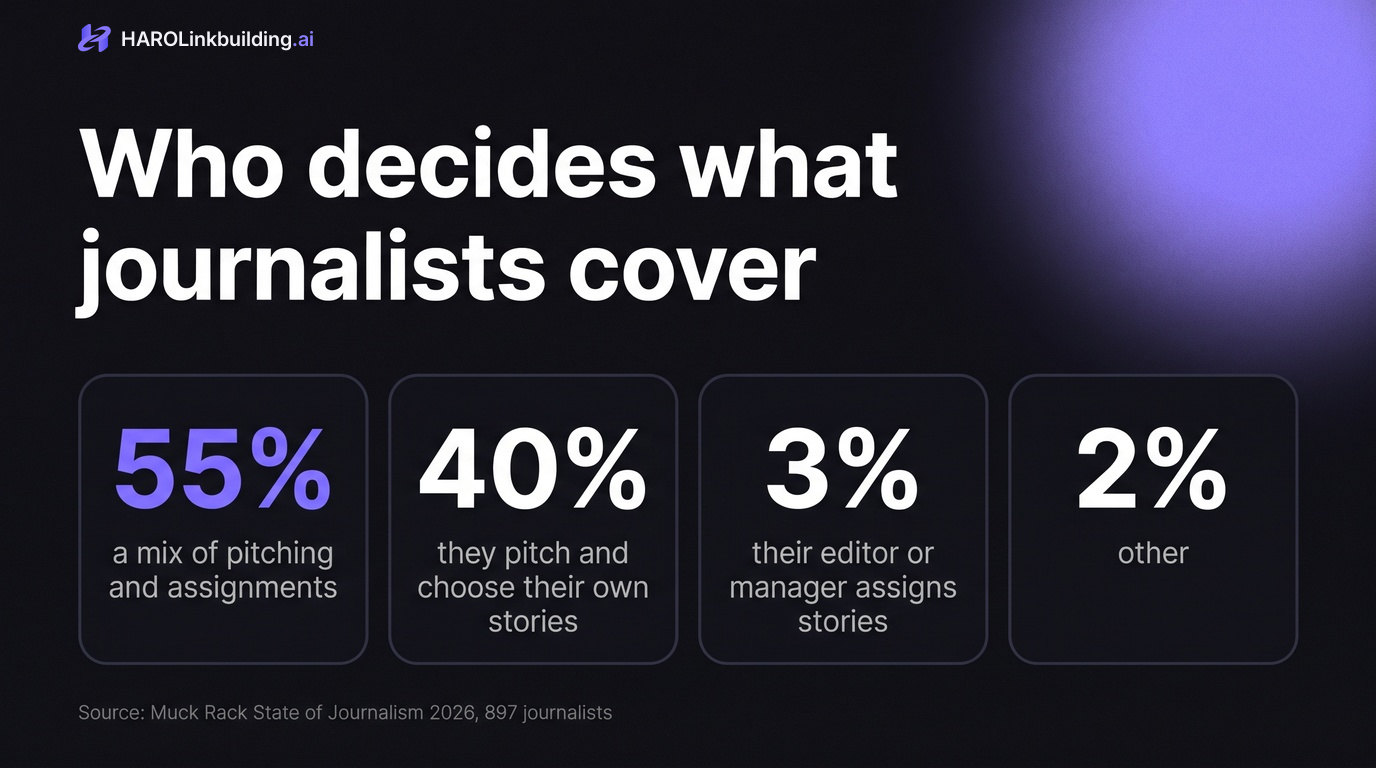
- 40% of journalists pitch and choose their own stories, and only 3% have their work fully assigned by an editor, according to Muck Rack's State of Journalism 2026.
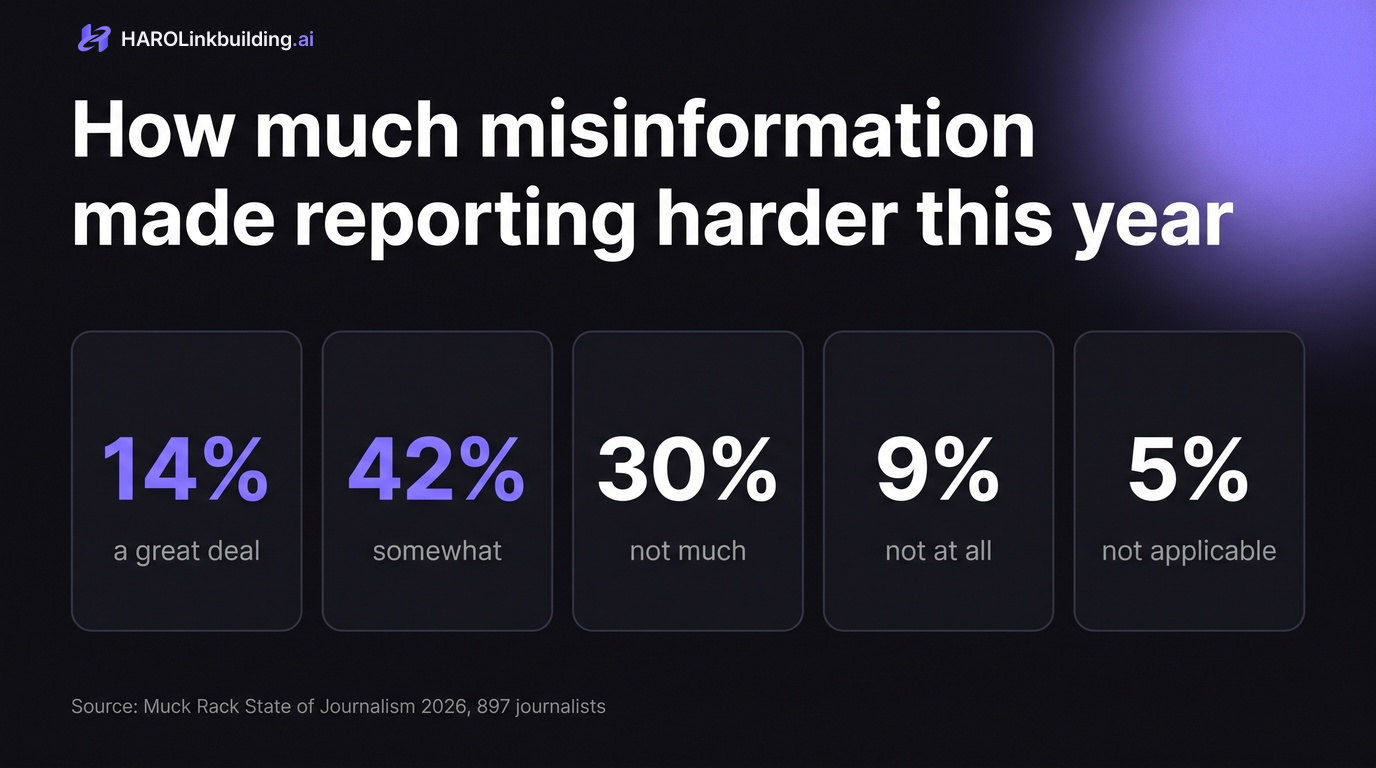
- 56% of journalists say misinformation made their reporting more difficult in the past year, in the same Muck Rack survey.
- Paid and advertorial content made up 0.3% of the links that ChatGPT, Claude and Gemini cited in Muck Rack's May 2026 study, while journalism made up about 27%.
What is an editorial backlink?
An editorial backlink is a link that a writer, editor or journalist adds to a published page because it helps their readers. Nobody paid for it, swapped a link for it or required it in a contract. The publisher keeps control of the decision to link, the anchor text, the target page and the rel attribute.
Three tests separate an editorial link from other links. All three have to be true:
- An independent person at the publication chose to include the link.
- No money, product, service or link was exchanged for it.
- The link gives readers a source, an example or more detail on the topic.
Most editorial links appear in news stories, trade articles, expert roundups and reference guides. In a typical case, a journalist quotes your expert and credits the company with a link to its website. In another, a writer cites a statistic from your research and links to the report.
Journalists have real control over what they cover. In Muck Rack's State of Journalism 2026 survey, 40% of journalists said they pitch and choose their own stories, and 55% said their work is a mix of pitching and assignments. Only 3% said an editor or manager fully assigns their stories.
That control explains why an editorial link carries weight. It also explains why nobody can promise you one. You can make your expertise easy to use, and the writer still decides whether to cite you.
How do editorial links differ from paid, sponsored, guest post, UGC and reciprocal links?
The difference comes down to two questions: who decided to place the link, and whether anything was exchanged for it. Google's spam policies define link spam as creating links "primarily for the purpose of manipulating search rankings". The examples include buying or selling links, exchanging goods or services for links, excessive link exchanges, and links with optimized anchor text in articles, guest posts or press releases distributed on other sites.
Google also explains how publishers should qualify outbound links with rel attributes. Paid placements get rel="sponsored", user-generated links such as comments and forum posts get rel="ugc", and rel="nofollow" covers other links a site does not want to be associated with. The spam policies add that paid links for advertising are acceptable when they carry nofollow or sponsored.
| Link type | Who decides to place it | What is exchanged | Google's guidance |
|---|---|---|---|
| Editorial link | The writer or editor | Nothing | No rel value is required. The publisher may still add one under its own policy. |
| Paid link or advertorial | The buyer, by agreement with the publisher | Money | Mark it with rel="sponsored" (nofollow is also acceptable). Paid links that pass ranking credit are link spam. |
| Sponsored content | The sponsor and the publisher | Money, products or services | Mark the links with rel="sponsored". |
| Guest post | The guest author writes it and the publisher accepts it | Content in return for a byline and a link | Google strongly recommends rel values on links in sponsored and guest posts. Optimized anchor text in guest posts is a link spam example. |
| UGC link | Any user of the site | Nothing from the publisher | Mark it with rel="ugc". |
| Reciprocal link | Two site owners by agreement | A link for a link | Excessive link exchanges are a link spam example. |
| Distributed press release | The company that issues the release | A distribution fee | Optimized anchor text in press releases distributed on other sites is a link spam example. |
A guest post or a link between two partner sites does not automatically break Google's rules. The risk grows when the main purpose is ranking credit, when the links use keyword-rich anchors or when the practice runs at scale. An editorial link avoids these questions because nobody bargained for it.
How can you tell if a link is editorial?
The code alone rarely answers the question. A nofollow link can be fully editorial, and a followed link can come from an undisclosed deal. Check the context around the link as well as the markup.
| Check | Points to an editorial link | Points to a paid or placed link |
|---|---|---|
| Page label | A standard news, feature or analysis article | A "Sponsored", "Partner content", "Paid post" or "Advertorial" label |
| Author | A staff journalist, editor or regular contributor | A byline from the company that receives the link |
| Anchor text | A brand name, a person's name, a plain URL or a phrase the writer chose | An exact-match commercial keyword that the linked company requested |
| How the link happened | The writer quoted you, cited your data or found your page | An invoice, a product swap, a link swap or a contract clause |
| rel attribute | Any value set by the publisher's own policy, including nofollow | rel="sponsored", which marks a paid placement |
To check the rel attribute, open the article in Chrome, right-click the link and choose Inspect. Look inside the <a> tag for rel="nofollow", rel="sponsored" or rel="ugc". Record what you find, because some publishers apply one rule to every outbound link.
For your own campaigns, the simplest test is the deal itself. If you paid for the link, traded for it or required it, the link does not count as editorial, whatever the page looks like.
Why do editorial backlinks matter?
Editorial links matter for three reasons: search engines still read links, independent mentions build reputation, and AI assistants draw heavily on earned media. Each reason has limits, so read the evidence carefully.
Links are still a signal Google uses
Google's guide to its ranking systems says it has systems that "understand how pages link to each other as a way to determine what pages are about and which might be most helpful in response to a query". It adds that PageRank "continues to be part of our core ranking systems". Google does not publish how much any single link counts, so treat each link as one input among many.
Independent mentions support reputation
Google's guide to creating helpful content describes E-E-A-T, which stands for experience, expertise, authoritativeness and trustworthiness, and says that "trust is most important". Google's Search Quality Rater Guidelines, dated September 11, 2025, tell raters to look for "independent reviews, references, recommendations by experts, news articles" when they research a website's reputation.
Google says rater data is not used directly in its ranking algorithms. The guidelines still show what Google treats as evidence of a good reputation, which is what independent sources say about a business. Our guide to HARO link building and SEO strategy covers rel attributes, E-E-A-T and measurement in more depth.
AI assistants cite journalism and earned media
For its May 2026 study, What Is AI Reading?, Muck Rack analyzed more than 25 million links that ChatGPT, Claude and Gemini cited in their answers. Journalism made up about 27% of those citations. Paid and advertorial content made up 0.3%, and press releases made up 1.1%.
Read these figures with two limits in mind. Muck Rack sells AI visibility tools, and it labels the numbers as "subject to slight tweaks". A citation in an AI answer is also a separate thing from a backlink. The data shows where AI systems look for sources. It does not measure how links affect rankings.
How do you earn editorial backlinks?
Every method below follows the same principle. You give a journalist or writer something their readers need, and you let them decide how to credit you. Pick the routes that match your expertise and the time you can commit.
| Route | What you supply | Best fit |
|---|---|---|
| Journalist requests | Fast, specific answers to published queries | Teams with a named expert who can reply within hours |
| Expert commentary | A clear view on news in your field, offered to reporters on that beat | Experts with a defined specialty and time to follow the news |
| Original data | A survey, benchmark or analysis with a stated method | Companies with useful internal data or a research budget |
| Reference resources | A page that defines, explains or measures something writers need to cite | Teams with deep subject knowledge and an editor |
1. Answer journalist requests
Request services such as HARO, Featured and Qwoted publish queries from reporters who need sources. You answer the question, the journalist chooses which answers to use, and a published quote often comes with a credit link. HARO describes its daily media queries as free for sources.
Our guide to getting backlinks through HARO walks through the full process, from filtering queries to tracking placements. For answers that read well, see our HARO pitch examples. If you want more than one source of requests, compare the best HARO alternatives.
2. Offer expert commentary on your field's news
Reporters on a beat need informed comment when news breaks. Build a short list of journalists who cover your field, read what they publish, and offer a brief, specific view when a story touches your expert's experience. Cision's 2026 State of the Media Report found that 42% of journalists want PR professionals to send them more access to experts and interview opportunities.
Offer comment only where your expert has direct experience. Include one concrete detail the reporter could use, such as a figure from your own work or an example from a recent project.
3. Publish original data
Data gives a journalist something new to report. In Cision's report, data or research topped the list of resources journalists want more of from PR professionals, at 47%. A useful study answers a clear question, states its sample and method, and produces findings a reporter can quote in one sentence.
Reporters also need numbers they can check. In Muck Rack's survey, 14% of journalists said misinformation made their reporting a great deal more difficult in the past year, and another 42% said it made reporting somewhat more difficult.
Publish the method, the sample size, the survey dates and the exact question wording next to the results. A reporter can then verify your numbers quickly, and the results page gives them a natural place to link.
4. Become the source writers cite
Some editorial links arrive without any outreach. Writers link to pages that define a term, explain a process or hold numbers they need. A glossary entry, a methodology page, a regularly updated benchmark or a clear explainer from a named expert can keep earning citations as long as it stays accurate.
Keep these pages factual and current. Name the author and their credentials, date every revision and keep sales copy off the page, because writers want a neutral source to send their readers to.
What does a realistic editorial link look like?
Expect less control than a paid placement would give you. The publisher decides every detail, and typical outcomes include the following:
- The anchor text is your brand name, your expert's name or a plain URL.
- The link points to your homepage or to the page the writer finds most useful.
- The link carries rel="nofollow" because the publisher applies that rule to outbound links.
- The story names your company and includes no link at all.
- The link sits in a credit line or an author bio instead of the main text.
A nofollow editorial link still has value. Google's announcement on link attributes says sponsored, ugc and nofollow "are treated as hints about which links to consider or exclude within Search". The link can also send referral visitors and show buyers that a publication quoted your expert.
The example below shows a short editorial mention. Our editorial team wrote it to illustrate the format, and every name in it is a placeholder.
Example written by our editorial team (not a real article)

Publication: [Trade publication], article on payroll compliance

"Most payroll errors surface at quarter-end, when nobody
has time to trace them," says [Expert name], head of
payroll operations at [Company]. "A short monthly
reconciliation catches them while they are still small."

Published link: "[Company]" linked to [company website]
Anchor text: the brand name, chosen by the editor
rel attribute: nofollow, the publication's standard setting
Notice what the expert did not ask for. There was no request for a keyword anchor, a followed link or a link to a product page. Requests like these push the relationship toward the exchanges Google describes as link spam.
If a story credits you without a link, send one polite note with the correct URL and accept the editor's answer. Our list of HARO link building mistakes covers other habits that cost placements.
How should a B2B team start earning editorial links?
Start small and measure from the first week. This six-step plan fits a team with one expert and a few hours a week:
- Choose one named expert and list five to ten topics they can speak on with evidence.
- Write a credit line with their full name, job title, company and the URL you want credited.
- Pick one or two routes from the table above and set a weekly time budget for each.
- Build or update one citable resource, such as a data page with a stated method.
- Log every pitch and placement with the story URL, anchor text, target page and rel attribute.
- Review the log after 30 days and keep the topics and outlets that produced coverage.
If your team has little time, you can automate the reading and sorting of requests. Our guide to automating journalist outreach shows how to do that while a person stays in charge of every pitch.
HAROLinkbuilding.ai, our own product, uses an AI agent to read journalist requests and draft pitches from your expert's input, and a person approves every pitch before it is sent. Plans are billed monthly with no per-link fee, and you can compare them on our pricing page.
Frequently asked questions
What is an editorial backlink?
An editorial backlink is a link that an editor or journalist chooses to include because it helps readers, with no payment or exchange behind it. The publisher controls the anchor text, the target page and the rel attribute.
Are editorial backlinks always dofollow?
Editorial links are not always dofollow, because the publisher decides the rel attribute and some publishers add nofollow to all outbound links. Google says it treats nofollow, sponsored and ugc as hints about which links to consider or exclude.
Is a guest post an editorial backlink?
Usually it is not, because the linked company or its author writes the content. Google strongly recommends rel values on links in sponsored and guest posts, and its spam policies list optimized anchor text in guest posts as an example of link spam.
Can you buy editorial backlinks?
A link you pay for is a paid link, whatever the page looks like. Google accepts paid links for advertising when they carry rel="sponsored" or rel="nofollow", and it treats paid links that pass ranking credit as link spam.
How do you earn editorial backlinks?
Answer journalist requests, offer expert commentary on news in your field, publish original data with a stated method and keep citable reference pages. Each route gives writers something their readers need and leaves the decision to link with them.
Do editorial links matter for AI search?
Muck Rack's May 2026 study found that journalism made up about 27% of the links cited by ChatGPT, Claude and Gemini, while paid and advertorial content made up 0.3%. An AI citation is separate from a backlink, so treat this as evidence of where AI systems look for sources.