

Quick answer
To earn backlinks naturally, give journalists something they want to cite: a named expert they can verify, a fast and specific answer to their question, or original data with a clear method. Build an expert profile, answer journalist requests and breaking stories inside your field, publish citable data on a well-organized press page, and pitch angles that fit each journalist's audience. The publication decides whether to link, so log every link and mention and refine your topics each month.
Key facts about earning natural backlinks
- 47% of journalists want more data or research from PR professionals, and 42% want more access to experts or interview opportunities, according to Cision's 2026 State of the Media Report.
- 58% of journalists say a PR pitch should ideally offer interview access to relevant sources, and 40% value original data or research, according to Muck Rack's State of Journalism 2026.
- 40% of journalists pitch and choose their own stories, and another 55% say their stories come from a mix of pitching and assignments, according to the same Muck Rack survey.
- 71% of PR professionals say low response rates from journalists made earned media harder to secure this year, according to Muck Rack's State of PR 2026.
- Google's link spam policy lists links with optimized anchor text in articles, guest posts or press releases distributed on other sites as an example of link spam.
What does it mean to earn backlinks naturally?
A natural backlink is a link that a journalist or editor chooses to add because your expertise or data helps their story. You do not pay for it, trade for it or make it a condition of your help. Our guide to editorial backlinks covers the definition in more detail.
Google's link spam policy describes the opposite case: links created "primarily for the purpose of manipulating search rankings". Its examples include buying links, exchanging goods or services for links, and optimized anchor text in press releases distributed on other sites. Expert commentary and digital PR stay clear of those examples because the journalist decides what to quote and whether to link.
Most PR teams say earned coverage got harder this year. In Muck Rack's State of PR 2026, which drew 971 usable responses from PR professionals, 71% said low response rates from journalists made earned media harder to secure. Only 2% said it had not become more difficult.

The same survey points to an opening. 22% of PR professionals said limited access to executives, spokespeople or subject matter experts held them back. Journalists ask for that access, and 42% of them want more access to experts or interview opportunities in Cision's survey. A company that offers a real expert quickly, with evidence, solves a problem for both sides.
How do you build an expert profile that journalists trust?
Journalists check who is speaking before they quote anyone. Your expert needs a public footprint that confirms the name, role and experience in your pitch. Build it once and update it every quarter.
Start with the expert sheet
Our step-by-step guide to HARO backlinks explains how to write a one-page expert sheet with credentials, topics and the URL you want credited. Turn that sheet into public proof:
- Publish a bio page with the expert's full name, job title, credentials, years of experience and topics.
- Add a high-resolution headshot that journalists can download without asking.
- List two or three past quotes, talks or articles, with links to the original pages.
- Give a direct email address for media requests and state the expert's usual response time.
- Keep the expert's LinkedIn headline and job history consistent with the bio page.
Google's guidance on creating helpful content asks site owners whether it is "self-evident to your visitors who authored your content". Apply the same test to your expert. A journalist should be able to find the person, the credentials and the contact route within a minute or two.
Show the expert where journalists already look
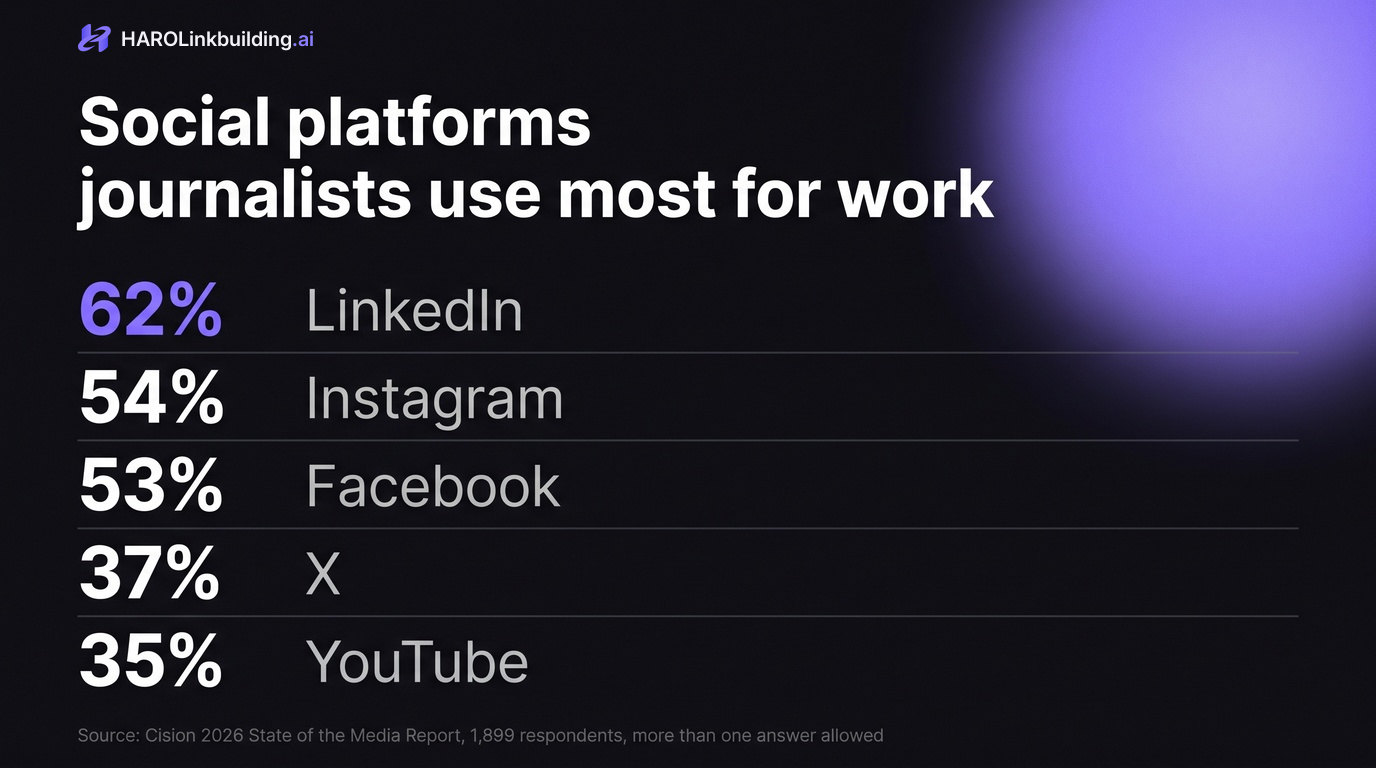
LinkedIn is the platform journalists use most for work. In Cision's survey of 1,899 journalists in 19 markets, 62% named it among the social platforms they use most frequently for professional purposes. Muck Rack found that 58% of journalists trust LinkedIn to treat journalistic content fairly, the highest share of any platform in its survey.
Use the expert's LinkedIn profile to post short, specific views on news in their field. Each post shows journalists how the expert thinks and builds a public record of commentary. Keep confidential client details and unapproved numbers out of every post.
How do you earn links with reactive expert commentary?
Reactive commentary means answering a journalist's specific request or reacting to news with real expertise. It is often the shortest path from expert to link, because the journalist already has a story and needs a source.
Answer journalist requests
Journalist request services send you questions from reporters who need sources. HARO offers free daily media queries, and Featured and Qwoted run similar request services. Our comparison of HARO alternatives explains how each one works.
Answer only the queries that sit inside your expert's topic list. Put the answer in the first two sentences, add one number or firsthand example, and finish with a credit line. Our guide on how to respond to HARO queries shows how to read a query and meet its rules.
Newsjack only with real expertise
Newsjacking means offering commentary on a breaking story. It works when the expert adds something the first reports lack, such as what the news means for buyers, a number from first-party data or a practical next step. A comment that only repeats the headline gives the journalist nothing to use.
- Comment only when the story sits inside the expert's topic list.
- Move quickly, because a comment loses value once the story has moved on.
- Pitch journalists who covered the topic recently, since most journalists choose at least some of their own stories.
- Avoid using another company's bad news to promote your product. In Cision's survey, 53% of journalists reject pitches that are too promotional or sales-focused.
Keep the commentary offer short
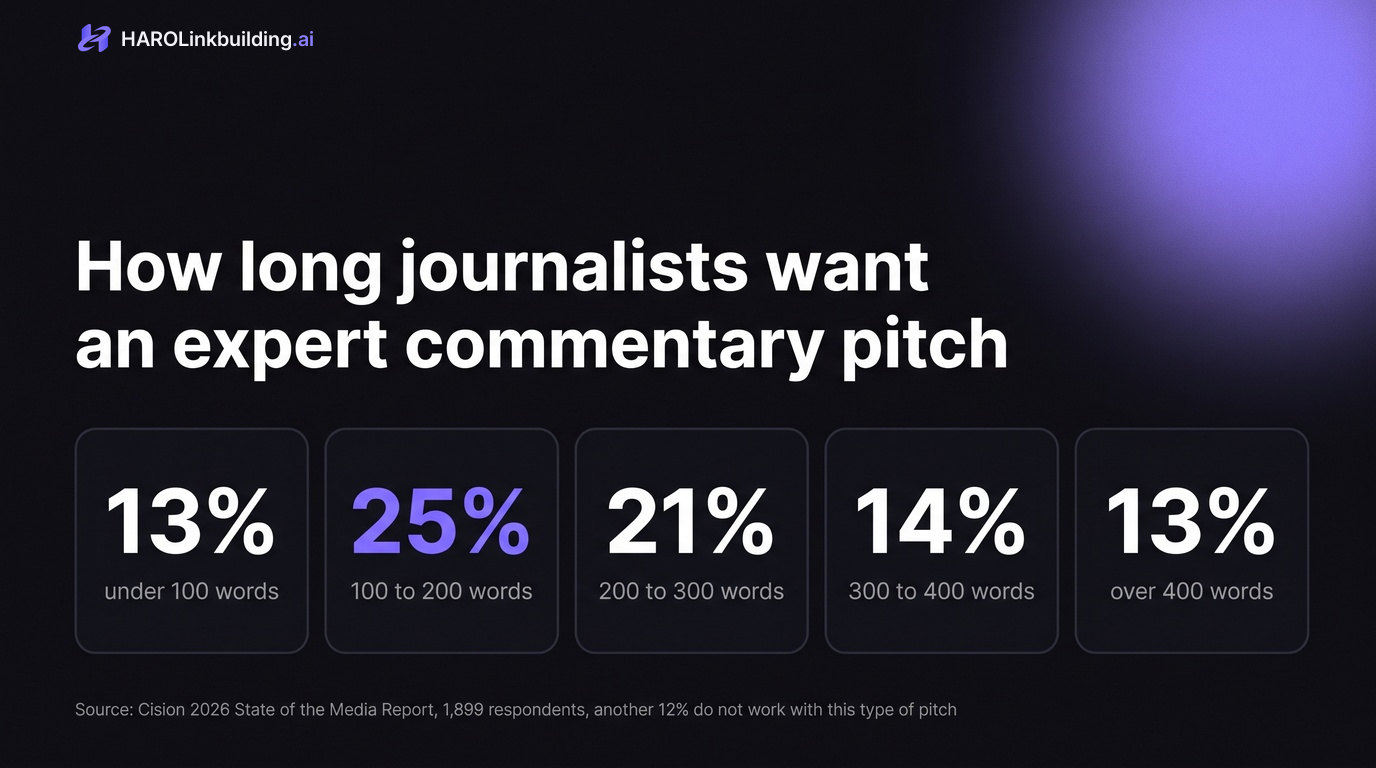
Cision asked journalists how long a pitch should be for each type of outreach. For an expert commentary or source offer, 100 to 200 words was the most common answer, at 25%. Another 13% preferred fewer than 100 words, so 38% want a commentary offer under 200 words by our calculation.
Use the template below for a newsjacking offer. Our 10 HARO pitch examples show other formats for request platforms.
Example written by our editorial team (not a real pitch):
How does proactive digital PR earn links?
Proactive digital PR creates something new for journalists to cover. For B2B companies, the most citable asset is usually original data: a survey, an analysis of anonymized product data or a benchmark built from public records. Data or research is the resource journalists most want more of from PR professionals, at 47% in Cision's survey.
Run each study through five steps:
- Pick a question that your buyers and the journalists who cover them care about, and check whether anyone has answered it with recent data.
- Choose a data source you can defend, such as a survey with a stated sample, your own anonymized product data or public data you have analyzed.
- Clean the data and write three to five findings as single sentences, each with one number.
- Publish the study on one stable URL with a method note, charts and a short summary.
- Pitch one finding to each journalist, matched to their beat, and offer the expert for an interview.
Journalists accept longer pitches for data. In Cision's pitch length question, 42% said a pitch about newly released data, a report or research can run to more than 300 words, while 25% wanted it under 200 words (our calculation from the chart). Put the context and the method in the pitch itself.
Google's content guidance asks whether a page provides "original information, reporting, research, or analysis". A study with a published method meets that test, and it gives journalists a page they can link as the source of the number. Add a method note like this one to every study.
Example written by our editorial team:
How do you make your assets easy to cite?
A journalist on deadline uses the source that is easiest to verify. One journalist quoted in Cision's report asked companies to make contact details, press releases and background information easier to find, especially for online outlets with tight deadlines. Prepare these assets before you pitch:
- Write each statistic as a full sentence with the number, the group it describes and the date.
- Put the method note on the same page as the findings.
- Offer each chart as a downloadable image with the source line inside the image.
- Build a press page with a media contact, company facts, logos, expert bios and headshots.
- Keep old studies on the same URL and add a dated note when you update the data.
Muck Rack's survey shows why these assets matter. 37% of journalists want high-resolution images with a pitch, while pre-written quotes rank lower at 14%. Give journalists the raw material and let them write the story.
How do you pitch an angle that fits a journalist's audience?
Relevance decides most pitches. Muck Rack found that 88% of journalists immediately delete pitches that are irrelevant to their coverage, and 71% delete pitches that feel overly promotional or advertorial. An angle fits when it answers a question the journalist's readers already have.
- Read the journalist's last five stories and note the audience, the format and the kinds of sources they quote.
- Write the angle as one sentence that names the reader: "[Readers] can [benefit] because [finding or expert view]."
- Match the evidence to the outlet. A trade publication usually wants process detail and numbers, while a general outlet wants the effect on people and companies.
- Offer access to the expert. Muck Rack found that 26% of journalists delete pitches that lack any source access.
- Send one follow-up at most and reply quickly when the journalist responds.
Muck Rack also found that 78% of journalists consider a pitch genuinely relevant when it directly affects the community their audience belongs to. For a B2B company, that community is usually an industry, a job role or a region. Name it in the first line of the pitch.
Which tactics should a B2B team start with?
The table compares the main tactics for earning links through expert commentary and digital PR. The effort ratings are our editorial judgment, based on the inputs each tactic needs, and they are not survey data.
| Tactic | What it needs | Typical output | Effort (our judgment) |
|---|---|---|---|
| Expert bio page and press page | Bio, headshot, credentials, media contact, company facts | A page journalists can verify and link in a credit | Low, with a quarterly update |
| Journalist request platforms | A named expert, daily triage and fast approvals | Quotes in roundups and explainers, sometimes with a link | Medium, every weekday |
| Newsjacking commentary | An expert who can react within hours and a list of relevant journalists | Quotes in follow-up and analysis stories | Medium, with unpredictable timing |
| Data snippets from first-party data | Anonymized product or customer data and approval to share it | Single numbers that strengthen pitches and commentary | Medium |
| Original data study | A defensible data source, an analyst, a method note and charts | A citable asset that can attract links for months | High |
Most teams should start with the first three rows. They need little budget and they produce a steady flow of quotes while you prepare your first study.
How do you measure links and mentions?
Record every pitch and result in one log. The publication controls the link, so expect four outcomes: a followed link, a qualified link such as nofollow, a mention without a link, or no coverage. Our guide on how HARO link building supports your SEO strategy explains how these links fit a wider SEO plan.
| Metric | How to calculate it | Where the data comes from |
|---|---|---|
| Selection rate | Published quotes divided by pitches sent | Your pitch log |
| Link rate | Published links divided by pitches sent | Your pitch log and the live stories |
| Link type | Followed, qualified or unlinked, per placement | The link code on each live story |
| Linking sites | New sites that link to you each month | Search Console and your log |
| Referral visits | Sessions from each story's domain | Your analytics tool |
The Search Console Links report shows your top linking sites and top linked pages. Google says it shows a sample of links and does not specify whether a link is marked nofollow, so inspect each live story and keep your own log as the record.
When a story mentions your expert without a link, send one polite note with the correct URL and accept the editor's decision. Report the results in plain numbers. In Muck Rack's State of PR 2026, 69% of PR professionals said producing measurable results is the best way to increase the perceived value of PR.
What does a 30-day starter plan look like?
This plan suits a B2B team with one expert and a few hours a week. It builds the foundation first and starts pitching in the second week.
- Days 1 and 2: Choose one named expert, write the expert sheet and list five to ten topics they can speak about with confidence.
- Days 3 to 5: Publish or update the expert's bio page and headshot, and align their LinkedIn profile with it.
- Days 6 and 7: Build a press page with a media contact, company facts, logos and expert bios.
- Day 8: Register as a source on HARO and one other request platform, and route every query to one shared inbox.
- Days 8 to 30: Review requests every weekday and pitch only the queries that fit the topic list.
- Days 9 and 10: List 20 journalists who covered the expert's topics in the last three months, with one story URL for each.
- Days 11 to 14: Set up news alerts for the expert's topics and agree who can approve a same-day comment.
- Days 15 to 21: Find one dataset you can publish, such as anonymized product data, and draft three findings with a method note.
- Days 22 to 26: Publish the findings on one URL and pitch one finding to each journalist on your list.
- Days 27 to 30: Review the log, calculate your selection and link rates, and drop the topics that produced no coverage.
After 30 days you will have a baseline from your own log. We have not found a reliable public benchmark for how many pitches it takes to earn a link, so set targets from your own numbers. Our guide to high-quality backlinks explains how to judge which placements are worth the effort.
Some teams have the expertise and lack the time to read requests every day. HAROLinkbuilding.ai uses an agent to read every digest and draft pitches, and a person approves every send. You can compare the plans on our pricing page.
Frequently asked questions
Can you earn backlinks without paying for them?
Natural links never require payment. Google's link spam policy lists buying links and exchanging goods or services for links as link spam, and natural links come from journalists and editors who choose to cite your expert or your data.
Do journalists always link to the experts they quote?
The publication decides whether to link, and some stories credit a source without a URL. Send one polite note with the correct URL for an unlinked mention and accept the editor's decision.
How long should an expert commentary pitch be?
In Cision's 2026 State of the Media survey, 100 to 200 words was the most common preference for an expert commentary or source offer, chosen by 25% of journalists. Another 13% preferred fewer than 100 words.
What do journalists want most from PR professionals?
In Cision's 2026 survey, 47% of journalists wanted more data or research, 45% wanted more embargoed or early access information and 42% wanted more access to experts or interview opportunities.
Are press release links natural backlinks?
Google's link spam policy lists links with optimized anchor text in press releases distributed on other sites as an example of link spam. Use press releases to share news, and let journalists decide whether to cite and link your page.
How long does it take to earn a natural backlink?
We have not found a reliable public benchmark for how many pitches it takes to earn a link. Run a 30-day plan and use your own selection rate and link rate as the baseline.
Does Search Console show every backlink?
Google says the Search Console Links report shows a sample of links and does not specify whether a link is marked nofollow. Keep your own log and inspect each live story.