

Quick answer
A strong HARO pitch answers the journalist's question in its first two sentences, shows why the expert is qualified, adds one piece of evidence and ends with a clear credit line. Keep it under 200 words and send it by email well before the deadline. Our editorial team wrote the ten HARO pitch examples below as samples. Each one answers a different type of query that B2B sources see, from data requests to follow-ups, and explains why it works.
Key facts about HARO pitches
- Most journalists prefer pitches of 200 words or fewer, according to O'Dwyer's coverage of Muck Rack's State of Journalism 2026.
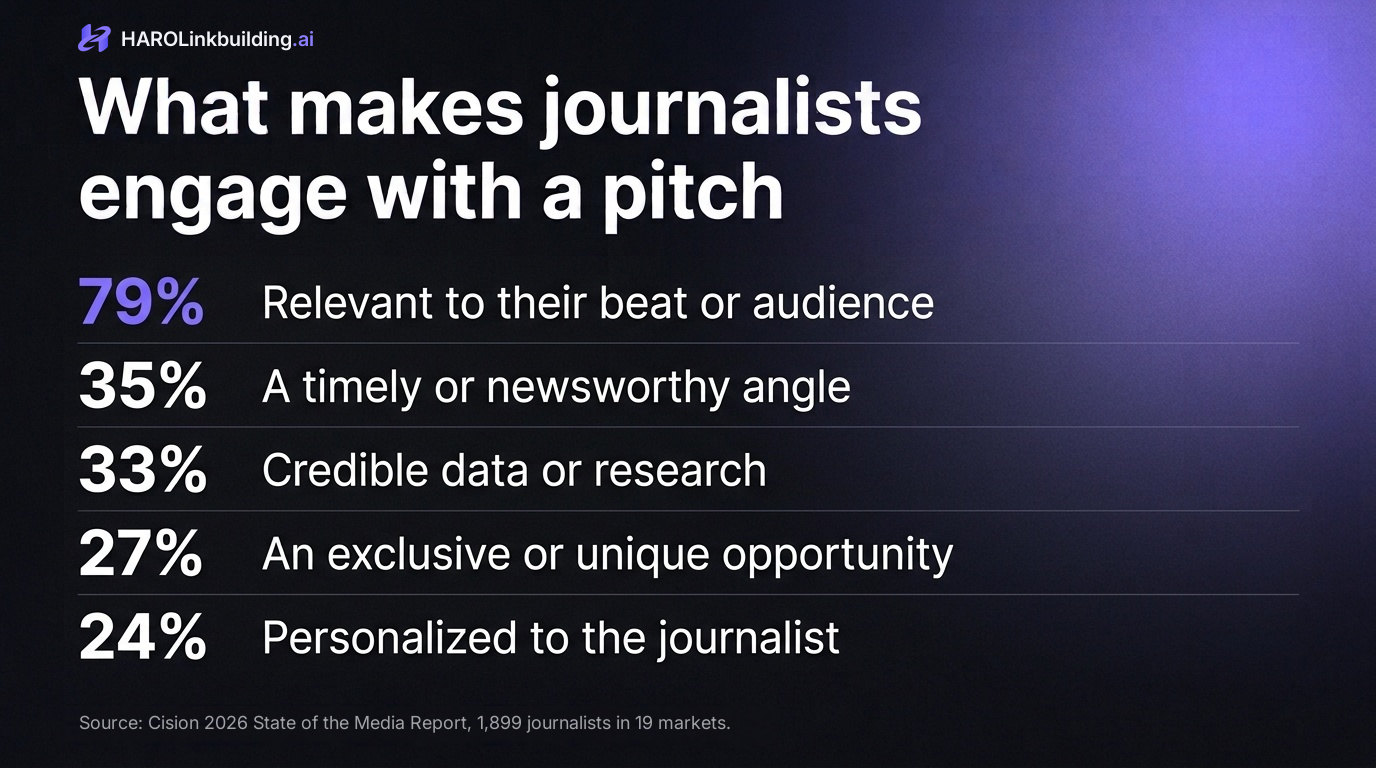
- 79% of journalists say relevance to their beat, audience or coverage area makes them more likely to engage with a pitch, according to Cision's 2026 State of the Media Report.
- Data or research is the resource journalists most want more of from PR professionals, chosen by 47% in the same report.
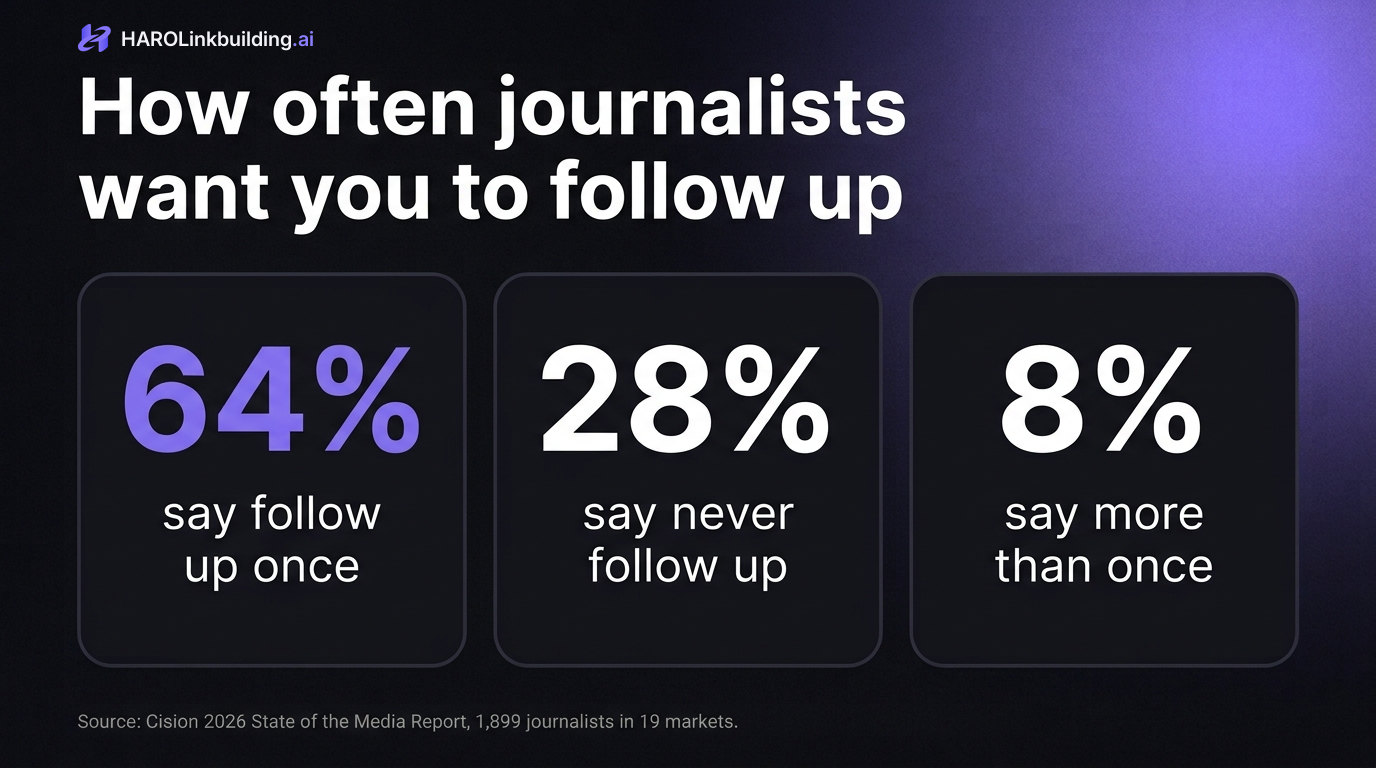
- 97% of journalists prefer to receive pitches by email, and 64% say a PR professional should follow up once.
- HARO sends sources up to three email digests per day, Monday through Friday, and sources pitch directly by email, according to HARO's About page.
What do the best HARO pitches have in common?
Every example in this post uses the same seven parts. In Cision's survey, 72% of journalists said that 25% or fewer of the pitches they receive are relevant. Each part below helps a pitch reach that relevant group.
| Part | What it looks like | What the research says |
|---|---|---|
| Clear subject line | The query topic and the expert's role | 17% engage more with a clear and compelling subject line (Cision). |
| Direct answer first | The answer in the first two sentences | 40% dismiss pitches that are unclear or too long (Muck Rack). |
| Matching credential | One line on why the expert qualifies | 23% engage more when a pitch offers credible experts (Cision). |
| One piece of evidence | A number or firsthand example, with its source | 33% engage more with credible data or research (Cision). |
| Under 200 words | Short paragraphs and no company history | Most journalists prefer 200 words or fewer (Muck Rack). |
| Credit line and contact | Name, title, company, URL and a phone number | 52% expect a reply within 24 hours, and 30% within an hour (Cision). |
| Early email send | A plain email sent once the expert approves it | 97% prefer email (Cision), and 78% want pitches before noon (Muck Rack). |
These examples assume you have already picked a query that fits your expert. Our step-by-step guide to HARO backlinks covers that filtering, and our guide on how to respond to HARO queries explains how to read a query before you write. New sources can start with how to use HARO.
What do 10 strong HARO pitch examples look like?
Our editorial team wrote every query and pitch below as a sample, and none of them is a real pitch or published quote. Replace each bracket with a verified detail from your own expert.
Example 1: A request for original data
Sample query (written by our editorial team): "I'm writing about how B2B buyers research software before they contact sales. Please share original survey or usage data, with the sample size and method."
Why it works: Data or research is the resource journalists most want more of, at 47% in Cision's survey. The finding gets its own line, and the method states its limit, so the journalist can judge the number before quoting it.
Example 2: An expert tip list
Sample query (written by our editorial team): "I'm compiling tips for reducing churn in B2B SaaS. Send one to three tips of one or two sentences each. I prefer answers from customer success leaders."
Why it works: The pitch follows the requested format exactly, and the credential matches the preferred source. Relevance is the top reason journalists engage, at 79% in Cision's survey.
Example 3: A founder or origin story
Sample query (written by our editorial team): "I'm writing about founders who started a B2B company after they saw a problem at a previous job. Tell me your story in under 150 words, including the problem."
Why it works: The pitch stays inside the word limit and names the problem early, as the query asks. It mentions the company's growth in one sentence only. That restraint matters because 53% of journalists in Cision's survey reject pitches that are too promotional.
Example 4: A SaaS or software tool question
Sample query (written by our editorial team): "Which software tool saved your operations team the most time this year? Explain how you use it. I don't want vendors pitching their own products."
Why it works: The pitch names the tool at once and gives a before-and-after measure. It also states any commercial tie, because the FTC's endorsement guidance says a connection that consumers would not expect should be disclosed clearly when it would affect how they judge the endorsement.
Example 5: A finance or pricing question
Sample query (written by our editorial team): "I'm looking for B2B finance or pricing leaders to explain how to raise prices for existing customers. What should companies do, and what should they avoid?"
Why it works: The pitch answers both halves of the question in separate short paragraphs, and the CFO title matches the request. The bracketed result marks where a real figure from your records belongs.
Example 6: An HR or hiring question
Sample query (written by our editorial team): "I'd like HR leaders to tell me the biggest mistake companies make when they hire their first salesperson. I need answers by [time] today."
Why it works: The answer follows the credential at once, and the last line confirms the expert can respond in time. Muck Rack's summary of eight years of journalist surveys found that 78% of journalists want pitches before noon, so send a same-day answer as early as you can.
Example 7: A cybersecurity question
Sample query (written by our editorial team): "I'm writing about what small businesses should do right after an employee clicks a phishing link. I'd like comments from security professionals with incident response experience."
Why it works: The pitch proves the required experience in one line, then gives numbered steps a journalist can quote or turn into a sidebar. Cision found that 52% of journalists expect a reply within 24 hours when they reach out, and the closing line shows the expert can respond the same day.
Example 8: A contrarian or myth-busting angle
Sample query (written by our editorial team): "For a myth-busting piece, I want B2B marketers who disagree with a common piece of marketing advice. Tell me the advice, why you disagree and what you do instead."
Why it works: The pitch states its view in the first line and backs it with a result from the expert's own work. Cision found that 34% of journalists reject pitches with no clear point of view.
Example 9: A quick one-line stat request
Sample query (written by our editorial team): "I need one statistic about how many B2B companies use AI tools in their sales process. Please include the source. One sentence is enough."
Why it works: The journalist asked for one sentence, so the pitch gives one sentence and a source line. Naming the dataset and date range lets the journalist check the claim.
Example 10: A follow-up after no reply
Sample situation (written by our editorial team): You answered a query about [topic] two days ago. The deadline is tomorrow, the query does not ask sources to avoid follow-ups and you have not heard back.
Why it works: The follow-up is short, sent once in the same thread and adds something new. In Cision's survey, 64% of journalists want one follow-up. Muck Rack respondents dismiss pitches sent repeatedly without a response (46%), so treat this email as your last one.
Which mistakes sink a HARO pitch?
Both 2026 journalist surveys point to the same problems, and each one has a simple fix.
| Mistake | What the research says | Fix |
|---|---|---|
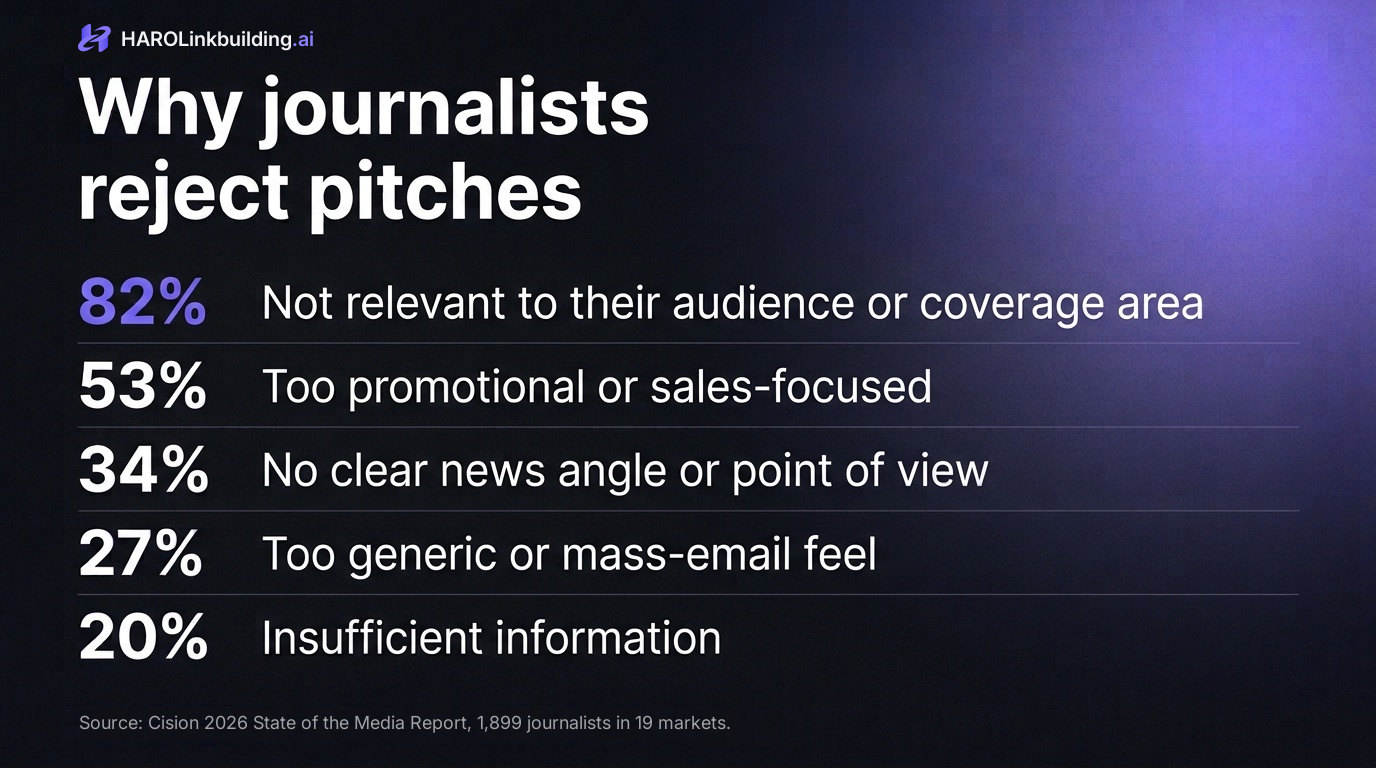
| Pitching outside your field | 82% reject pitches that are not relevant to their audience (Cision). | Answer only queries that match your expert's topics. |
| Sales language | 53% reject overly promotional pitches (Cision), and 71% dismiss them in Muck Rack's survey. | Keep your company in the credit line. |
| A mass-email feel | 50% dismiss pitches that look like a mass email (Muck Rack). | Write each pitch for one query. |
| Repeated follow-ups | 46% dismiss pitches sent repeatedly without a response (Muck Rack). | Follow up once. |
| Fully AI-generated answers | About 1 in 3 human pitches were selected on Featured, against 1 in 10 fully AI-generated ones (Pangram Labs). | Have the expert supply the facts and approve the text. |
Featured supplied Pangram's data, and Pangram sells AI detection software, so read those figures with care. Never ask for keyword-rich anchor text, because Google's spam policies list optimized anchor text among their link spam examples.
How do you turn these examples into your own pitches?
- Pick the example closest to the query type you are answering.
- Replace every bracket with a verified detail, and delete any line you cannot support.
- Match the query's format and word limit, then ask the expert to approve the text.
- Log each pitch and its outcome to see which query types earn coverage.
The full process is in our guide to getting backlinks through HARO. HAROLinkbuilding.ai uses an AI agent to read requests and draft pitches, and a person approves each pitch before it is sent. You can compare plans on our pricing page.
Frequently asked questions
How long should a HARO pitch be?
Keep it under 200 words unless the query sets a different limit. O'Dwyer's reports that most journalists in Muck Rack's 2026 survey prefer pitches of 200 words or fewer, and Cision puts the general sweet spot at around 100 to 200 words.
Are these HARO pitch examples real pitches?
Our editorial team wrote every sample query and pitch in this guide, and none of them is a real pitch or a published quote. Replace each bracketed placeholder with a verified detail from your own expert before you send anything.
What should a HARO pitch include?
Include a clear subject line, a direct answer, one line on the expert's credentials, one piece of evidence and a credit line with contact details. Cision found that 33% of journalists are more likely to engage with a pitch that includes credible data or research.
Should I follow up on a HARO pitch?
Follow up once at most, and skip it if the query asks for no further contact. In Cision's 2026 survey, 64% of journalists want one follow-up, 28% want none and 8% accept more than one.
How do HARO sources send pitches?
HARO says registered sources receive up to three email digests per day, Monday through Friday. Sources pitch their expertise directly by email, and a journalist who selects a source reaches out for the full quote or an interview.
Can I ask for a link or specific anchor text?
Put your URL in the credit line and leave the anchor text to the publication. Google's spam policies list links with optimized anchor text among their link spam examples.
Can I use AI to write a HARO pitch?
Use it with care. Pangram Labs reports that about 1 in 3 human pitches on Featured were selected, compared with 1 in 10 fully AI-generated pitches, so have a named expert supply the facts and approve the text.