

Quick answer
To get backlinks through HARO, register as a source for free, filter the journalist queries for topics where you have real expertise, and email a short, specific answer before the deadline. HARO sends up to three digests per day, Monday through Friday. When a journalist publishes your answer, you are credited, often with a link to your website. HARO does not promise a link, so run it as a repeatable pitching process and track every result.
Key facts about HARO backlinks
- HARO is free for all users and reports more than 800,000 registered sources and 75,000 journalists and bloggers, according to HARO's About page.
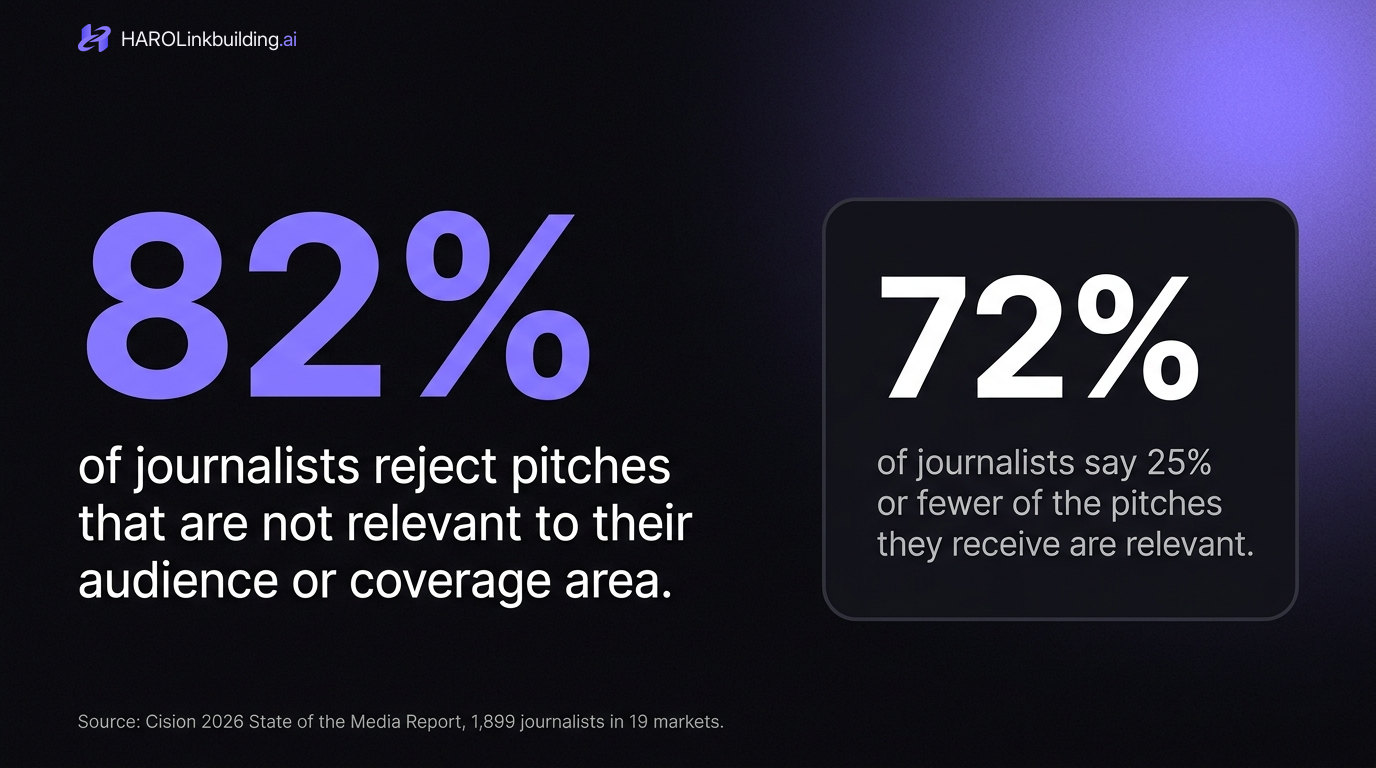
- 82% of journalists reject pitches that are not relevant to their audience or coverage area, according to Cision's 2026 State of the Media Report.
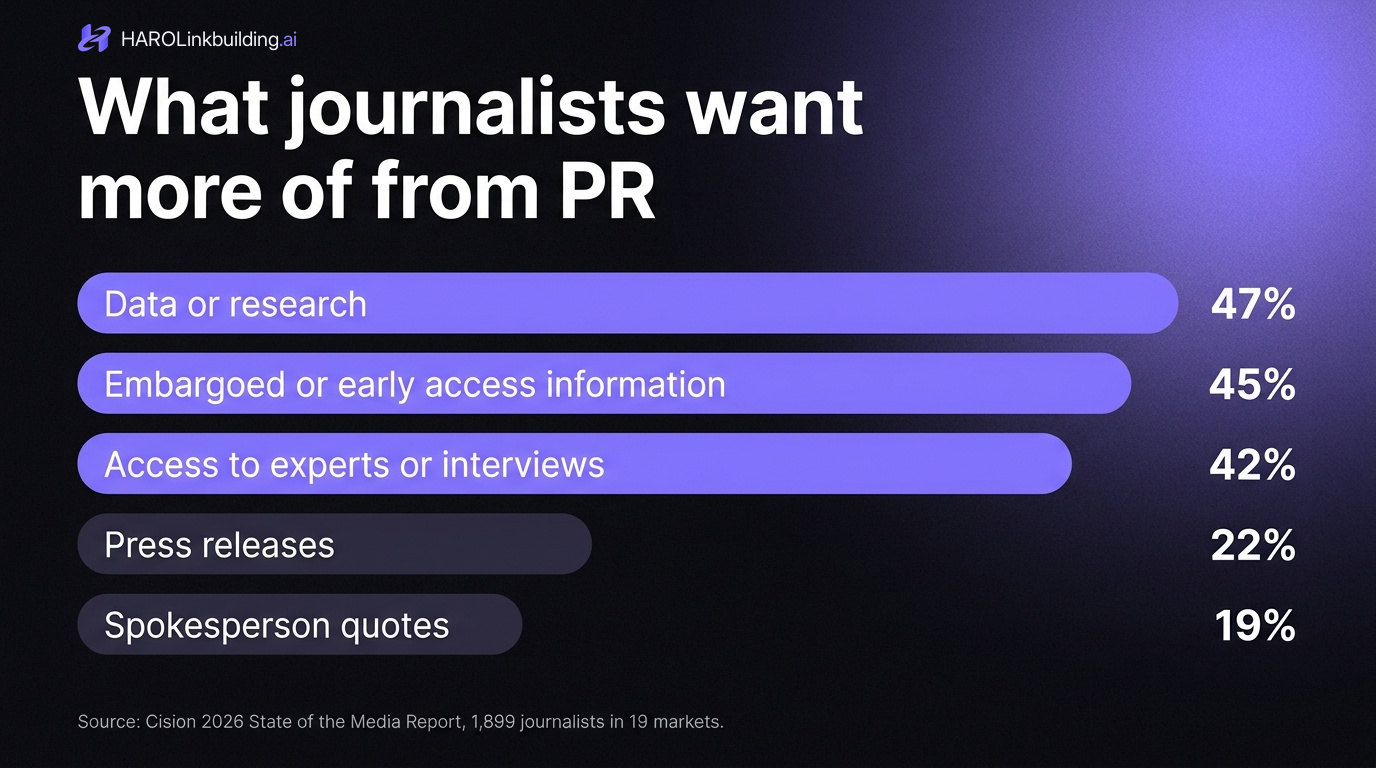
- Data or research is the resource journalists most want more of from PR professionals, at 47% in the same report.
- Most journalists prefer pitches of 200 words or fewer, according to O'Dwyer's coverage of Muck Rack's State of Journalism 2026.
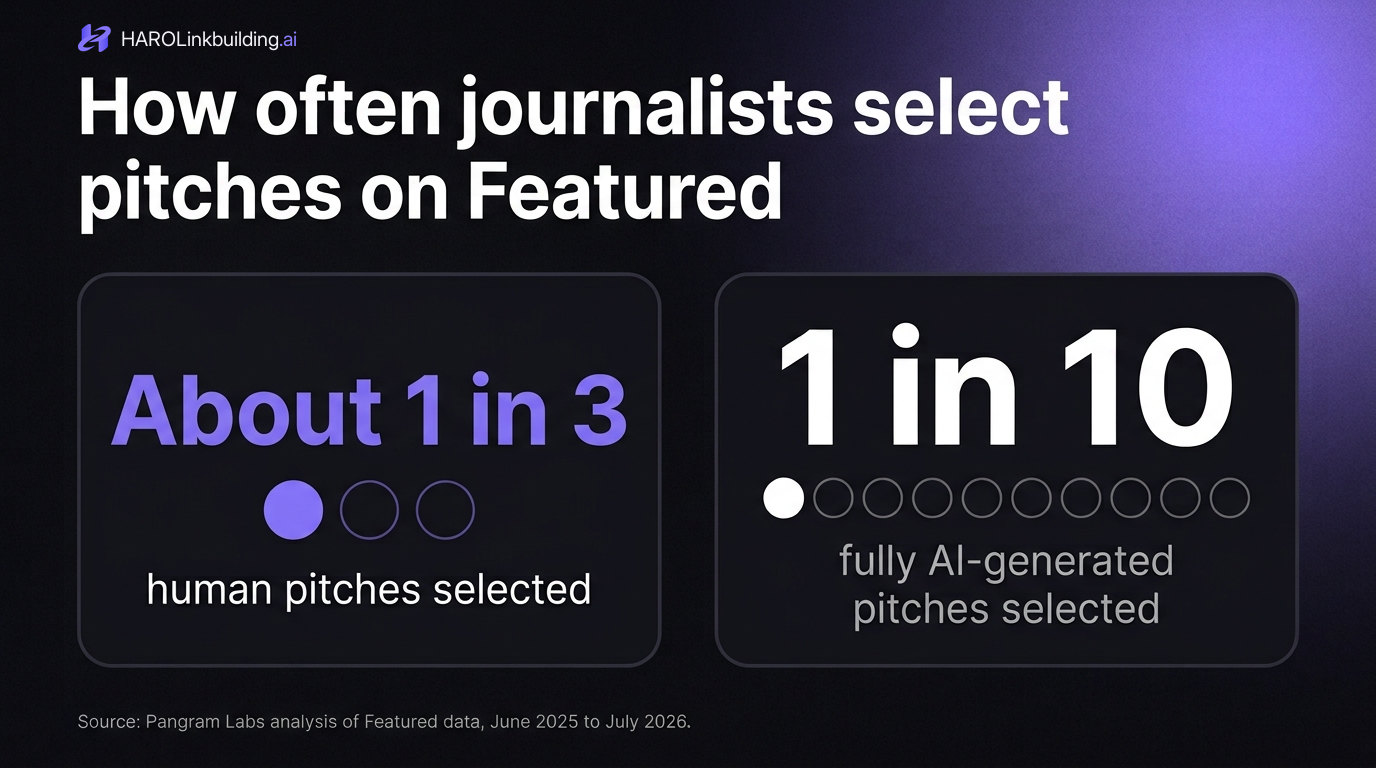
- On Featured, about 1 in 3 human pitches were selected, compared with 1 in 10 fully AI-generated pitches, according to Pangram Labs.
What is HARO, and does it still work in 2026?
HARO stands for Help a Reporter Out. It connects journalists who need expert sources with people who can answer their questions. A journalist submits a query with a topic and a deadline, sources receive the query by email, and the journalist contacts the sources they want to use.
HARO still works in 2026, although it has changed hands. Cision rebranded the service as Connectively in 2024 and later discontinued that product. Cision announced the sale of HARO to Featured.com on April 15, 2025, and the service now runs under Featured.
Demand for expert sources remains strong. In Cision's 2026 survey of 1,899 journalists in 19 markets, 66% said they rely on PR-provided content for story ideas. Muck Rack's 2026 survey, as reported by O'Dwyer's, found that 86% of journalists say at least some of their stories start with a PR pitch.
Competition is the harder part. Pangram Labs reviewed 1,394,740 pitches sent in response to 42,392 journalist requests across Featured, HARO and Connectively between June 2025 and July 2026. By our calculation, that is an average of about 33 pitches per request.
Why are HARO backlinks worth the effort?
A HARO backlink is an editorial link. A journalist chooses your answer because it helps the story, and the publication decides whether to link to you. That makes the link an independent signal that a publication trusted your expertise.
Google defines link spam as creating links "primarily for the purpose of manipulating search rankings". Its examples include paying for links, trading goods or services for links, and using automated programs to create links. Three rules keep your HARO work clear of those examples:
- Never pay a journalist or publication for a link in exchange for your quote.
- Never ask for keyword-rich anchor text.
- Never make a link a condition of your contribution.
A published answer can produce four outcomes. The publisher controls the result, so plan your reporting around all four.
| Outcome | What it means | What to do next |
|---|---|---|
| Followed link | The link has no rel qualifier. | Log the URL, the anchor text and the target page. |
| Qualified link | The link uses nofollow, sponsored or ugc. Google says these links will generally not be followed. | Log it and measure referral traffic and brand visibility. |
| Mention without a link | The story credits you and includes no URL. | Send one polite note with the correct URL and accept the editor's decision. |
| No publication | The story changed, or the journalist used other sources. | Log the query so you can review your topic fit each month. |
How do you get backlinks through HARO, step by step?
The process has seven steps. Set up the first two steps once, then repeat the rest for every digest.
Step 1: Choose one named expert and a clear topic list
Journalists quote people, so every pitch needs a real person with relevant experience. Write a one-page expert sheet before you send anything. Cover these points:
- State the expert's full name, job title and company.
- List their credentials and years of experience.
- Name five to ten topics they can speak about with confidence.
- Name the topics they will not comment on.
- Note any first-party data your company can share.
- Add the URL you want credited, a headshot and a short bio.
Google's guidance on helpful content encourages accurate authorship and warns against fabricated creator profiles. Apply the same standard to your pitches. Never invent an expert, a credential or a statistic.
Step 2: Register as a source and set up your inbox
Sign up as a source at helpareporter.com. HARO says registered sources receive up to three email digests per day, Monday through Friday. That can mean 15 digests each week, so give the work a clear owner.
- Create a mail filter that sends every digest to one folder.
- Assign one person to review each digest as it arrives.
- Agree who can approve a pitch on behalf of the expert.
Step 3: Filter every query before you write
Relevance decides most outcomes. In Cision's report, 79% of journalists said relevance makes them more likely to engage with a pitch, and 72% said that 25% or fewer of the pitches they receive are relevant.
Ask these five questions about each query. Pitch only when all five answers are yes.
| Question | Pitch when | Skip when |
|---|---|---|
| Does it match the topic list? | The query sits squarely inside the expert's field. | The connection is a stretch. |
| Does the expert qualify? | The expert meets every stated requirement. | The expert misses one requirement. |
| Can you add evidence? | You have a number, an example or a firsthand detail. | You only have a general opinion. |
| Is there enough time? | The expert can review the answer before the deadline. | Nobody can approve it in time. |
| Is the publication a good fit? | The outlet is real, editorial and read by your buyers. | The site is thin, unrelated or asks for payment. |
Step 4: Write a pitch a journalist can quote
Answer the question in your first two sentences and keep the whole pitch under 200 words. Journalists rarely need your company history. They need a clear answer, a reason to trust it and the details to credit you.
Evidence gives your answer more value. Cision found that 33% of journalists are more likely to engage with a pitch that includes credible data or research, while 53% reject pitches that are too promotional. Use this template and adapt it to the format the query requests:
Subject: [Query headline]: answer from [expert's role]

Hi [journalist's name],

I'm [full name], [job title] at [company]. I have
[one credential that matches this query].

[Direct answer to the question in one or two sentences.]

[One number, example or firsthand observation, with
where it comes from.]

[One practical takeaway for the journalist's readers.]

Credit: [full name], [job title], [company], [URL]

I can answer follow-up questions today at [email or phone].
Disclose any commercial tie that affects your comment. The FTC's endorsement guidance says a connection should be disclosed clearly when consumers would not expect it and it would affect how they judge the endorsement. This applies when a query asks you to recommend a product or company that pays you.
Step 5: Send it early and follow the query's rules
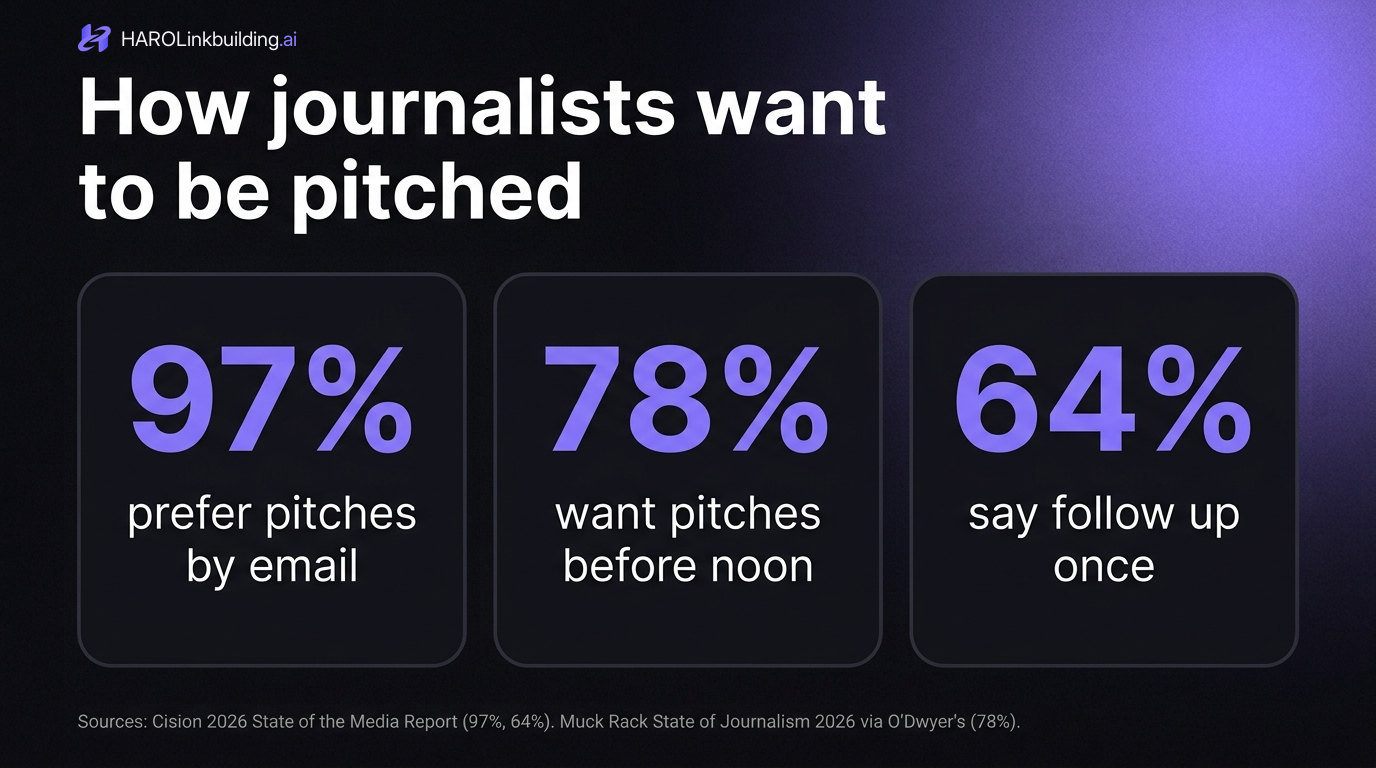
Follow any format, word limit or credential requirement in the query. HARO says sources pitch directly by email, which also suits most journalists. Cision found that 97% prefer to receive pitches by email.
The query's deadline comes first, and earlier is safer because a journalist can stop reading once they have enough sources.
Step 6: Follow up once and reply quickly
HARO says a journalist who selects a source reaches out directly for the full quote or an interview. Reply quickly when that happens. In Cision's survey, 52% of journalists expect a reply within 24 hours, and another 30% expect one within an hour.
Keep follow-ups to one. Cision found that 64% of journalists want one follow-up, 28% want none and 8% accept more than one. Skip the follow-up if the query asks for no further contact.
Step 7: Verify each placement and measure the results
Record every pitch in a shared sheet, including the ones that fail. Your own log becomes the best benchmark you have. Use these fields:
- Record the query date, publication and expert.
- Record the pitch status and story URL.
- Record the link type, anchor text and target page.
- Record the referral sessions from the story.
Open the published story and inspect the link to confirm its rel attribute. The Search Console Links report shows your top linked pages and top linking sites, but Google notes that it shows a sample of links, so your own log should remain the record. Google Analytics also added a dedicated way to measure traffic from AI assistants, which helps you see whether that traffic grows alongside your coverage.
Review two numbers each month:
- Selection rate equals published answers divided by pitches sent.
- Link rate equals published links divided by pitches sent.
What makes a journalist choose a pitch?
Relevance comes first, and useful evidence comes next. Cision asked journalists what makes them more likely to engage with a pitch and why they reject one.
| Factor | Share of journalists | Effect on your pitch |
|---|---|---|
| Relevant to beat, audience or coverage area | 79% | Raises engagement |
| Timely or newsworthy angle | 35% | Raises engagement |
| Credible data or research | 33% | Raises engagement |
| Access to credible sources or experts | 23% | Raises engagement |
| Not relevant to audience or coverage area | 82% | Causes rejection |
| Too promotional or sales-focused | 53% | Causes rejection |
| No clear news angle or point of view | 34% | Causes rejection |
The same survey shows which resources journalists want more of. They asked for data or research more than twice as often as spokesperson quotes, at 47% and 19%. A HARO answer with one verifiable number is therefore more useful to a journalist than a polished general opinion.
Can you use AI to write HARO pitches?
You can use AI to read queries and organize a draft, but a named expert should supply the facts and approve the final answer. The available data shows that fully AI-generated pitches perform poorly:
- Pangram Labs flagged 292,895 of the 1,394,740 pitches it reviewed, or roughly 21%, as fully AI-generated.
- Across Featured, 1 in 10 of those pitches were selected, compared with about 1 in 3 human pitches.
- 35% of a pool of more than 2,500 journalists chose not to receive pitches flagged as fully AI-generated.
- In Cision's survey, 53% of journalists oppose AI-generated pitches.
Read these numbers with two limits in mind. Featured supplied the data and Pangram sells AI detection software. The comparison also excluded mixed and AI-assisted pitches, so it tells you little about AI drafts that a person has reworked.
Pangram also reports that HARO does not ban sources solely for AI-generated pitches, although those pitches can trigger internal monitoring. Accounts that send a large volume of low-quality AI responses get filtered out.
We have a stake in this question. HAROLinkbuilding.ai uses an AI agent to read requests and draft pitches, and a person approves each pitch before it is sent. We recommend this division of work for any team:
| Task | Who should do it |
|---|---|
| Reading digests and matching queries to topics | AI or a trained assistant |
| Formatting a draft to the query's requirements | AI or a trained assistant |
| Supplying numbers, examples and opinions | The named expert |
| Checking every fact and approving the final pitch | A person who answers for the content |
What mistakes stop HARO pitches from earning links?
Most failed pitches share a small set of avoidable problems.
| Mistake | Why it costs you | Fix |
|---|---|---|
| Pitching outside the expert's field | 82% of journalists reject irrelevant pitches. | Use the five-question filter. |
| Sounding promotional | 53% reject pitches that are too promotional or sales-focused. | Answer the question and keep your company in the credit line. |
| Offering opinion without evidence | Journalists asked for data more than any other resource. | Add one number or firsthand example. |
| Following up repeatedly | O'Dwyer's reports that 46% of journalists reject pitches sent repeatedly without a response. | Send one follow-up at most. |
| Asking for specific anchor text | Google lists optimized anchor text in its link spam examples. | Provide a plain URL in your credit line. |
| Paying or trading for the link | Google treats these exchanges as link spam unless the link is qualified. | Decline the offer and move to the next query. |
How long does HARO link building take?
We have not found a reliable public benchmark for how many pitches it takes to earn a HARO link. Results depend on your expert, your topics and the time you can commit. Use your first 30 days to build a baseline from your own log, then adjust your topics using your selection rate and link rate.
Your team can run the process in-house or hand part of it to a provider. The right choice depends on who has the time to read digests and who holds the expertise.
| Option | Best fit | Main cost |
|---|---|---|
| In-house | Teams with an available expert and a person who can check every digest | Staff time |
| Agency | Teams that want a provider to manage outreach | Monthly or per-link fees |
| AI agent with human approval | Teams that have expertise and limited time for digests | Subscription fee |
The third option is the model we offer. You can review our pricing or check example links to see the kind of placements clients have earned.
HARO backlinks FAQ
Is HARO free?
Yes. HARO lists itself as free for all users, and sources can subscribe to its daily media queries at no cost.
How many HARO emails will I receive?
HARO says registered sources receive up to three email digests per day, Monday through Friday.
Does HARO guarantee backlinks?
No. HARO says a published source is credited, often with a link back to their website. The journalist and the publication decide whether to include a link.
Are HARO backlinks dofollow?
It depends on the publication. Some publishers leave links unqualified, and others add nofollow, sponsored or ugc attributes. Check each placement and record the result.
Are HARO backlinks safe for SEO?
Google's spam policies target links created mainly to manipulate rankings, including paid links without a qualifying attribute. You lower your risk when you earn placements on merit, pay nothing for the link and avoid requests for keyword-rich anchor text.
How long should a HARO pitch be?
Keep it under 200 words unless the query says otherwise. O'Dwyer's reports that most journalists in Muck Rack's 2026 survey prefer pitches of 200 words or fewer.
Who owns HARO now?
Featured.com owns HARO. Cision announced the sale on April 15, 2025.